
With the introduction of programmes like Strictly Dance Fever on mainstream television, styles of dance from bygone eras have been brought to the forefront of society’s consciousness. And with so many swing organisations running successfully in the UK and abroad today, it begs the question: Is the revived interest just a phase, or has the phenomenon been here all along? Furthermore, is the interest confined to the older generation who want to relive the dances of their youth or a younger crowd who feel compelled to try something new?
Perhaps the best place to start is with the origin of popular swing dances from the first half of the century. Typically black jazz dances such as the Charleston and The Cakewalk became more main stream in the 1920s and gave rise to the Lindyhop, which, in turn, evolved into the Jitterbug and Jive in the 1940s and 1950s. Along with developments in the style of dance there were changes in the accompanying music, from big band swing music in the 1940s to rhythm and blues and rock and roll in the 1950s. Popular artists of the time such as Glenn Miller and Little Richard took swing to new levels, helping to secure its place in musical history.
It wasn’t all about the music, of course. Swing’s meteoric rise to fame was helped in no small part by the war, when military or civilian service meant people of all social ages and groups mixed on a regular basis. The Jitterbug spread widely across the country during this period, and its exposure was not limited to the UK. Swing was soon a global phenomenon, and has remained so ever since, albeit on a smaller scale than at the height of the war.
But how have swing dances survived? Or more importantly, what has kept people interested? Robin Weathersbee, who co-founded Maddy’s Jiving School with his wife, attributes swing’s longevity to the power of the music, claiming that “the strong rhythms and ever-popular ‘classic’ tracks, which still get mainstream media exposure today, have kept the music and style of dancing in the public eye.”
Martin Ellis, founder of Swingland, an organisation providing weekly swing dance classes, workshops and club nights, further strengthens the argument that swing’s success lies in its originality; “Over the last hundred years or so we have been able to record music, which means that we can trace the roots of every style of music, making it increasingly harder to produce something original.”
So who actually attends swing classes today? According to Robin, most of his students are “much younger than the generation who would have danced to swing during the ‘40s and ‘50s.” Martin agrees, “We have all age groups taking part, from young people in their twenties to older people in their seventies – but the vast majority are in their twenties and thirties.”
This revelation may come as a surprise to many, but Martin explains why younger people find swing classes so appealing; “Although our younger participants enjoy pop and rock music and go to clubs just like anyone else of their age would do, one fairly common theme is that none of them are into the seedier side of clubbing, such as drugs. They enjoy going to an environment that is not fuelled by that, as its all about the music and dancing. I suppose you could say it’s more wholesome.”
It would therefore seem that the perception of the swing culture as a safe alternative to modern day forms of entertainment may be another reason for its prolonged success. This theory is given more credence if we consider the fifties lifestyle. People had less disposable income to spend on drinking and leisure pursuits than they do today, meaning the emphasis was on cheap forms of entertainment such as dancing. Society was just beginning to recover from the war, and dancing must also have provided a welcome release from the oppression of previous years.
So are television programmes like Strictly Dance Fever responsible for the recent resurgence of swing? “Television programmes are not necessarily the reason,” says Martin, “The swing scene in the UK, compared to the US and Europe, is not really about competition, so whilst such programmes do bring exposure they don’t generate a huge interest. It really comes down to the fact that the music is very good and the dances, although not easy to learn, are addictive once you have picked them up. There is also such a big scene worldwide that many people see it as a chance to go travelling and meet other like-minded people.”
For many, the interest extends into other areas of the fifties lifestyle. Robin and Collette Weathersbee are a perfect example. “Our interest started with the music of the era, but we now collect and wear vintage clothing, own a 1947 Plymouth convertible car and have furnished our home in period style,” says Robin.
Whatever the reason for the interest, it seems the swing culture is alive and well in today’s society, both in the UK and abroad. And long may it reign.
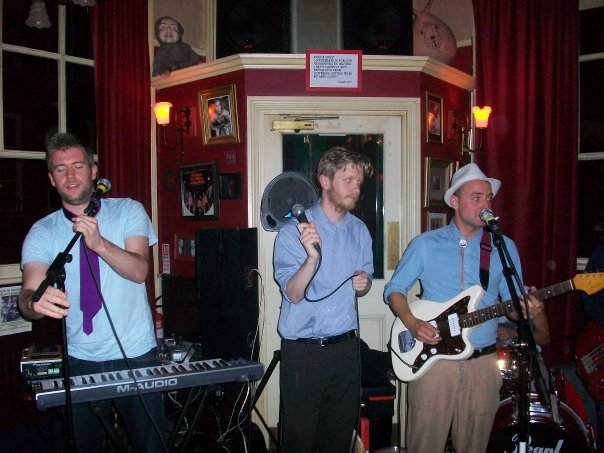
Writing this post reminded me of when my friend’s band played for my 29th birthday celebrations in a pub in Vauxhall. It was such a fun night!

 Belle 365