Sadness

At times in my life when I’ve experienced loss, grief and sadness I have often found it greatly cathartic to write about it. I suspect many other writers find that being melancholy is more conducive to being prolific in their craft than being happy, perhaps because it makes for more heartfelt and genuine content that the reader can not only engage with but also empathise with.

But sometimes when something is so recent and raw it’s hard to write about it, and that’s where I am right now. It takes time to process a tragic event and whilst you’re doing it there’s little space for anything else, which is why I’m finding it hard to carry on as normal with my daily blog posts-and indeed why I missed posting yesterday’s despite having written it on time.

Your brain closes down a bit to process grief, ignoring all non-essential things and effectively hibernating until the pain has lessened. I am only on the periphery of this terrible situation and yet I have been deeply and profoundly affected by it, and I feel an enormous amount of sympathy and sadness for those involved. I can’t say any more for now, it wouldn’t be fair. I just wanted to explain why I’m not quite myself, and why my daily musings are temporarily distracted.

Raw

Why do they say that the air is crisp, as if it were something that one could bite into, that one could touch? The air’s no crisper than the sun, though that at least would burn you to a crisp if you could get close enough to touch it.

It’s funny what thoughts pop into your mind, unbidden, after a traumatic life episode. Here I am, lacing up my boots – the ones with the dodgy soles that let the water in, which are really altogether pointless as it’s almost always wet outside – and instead of thinking about what’s happened I’m ruminating on the physical qualities of the air and the sun. I suppose this could be called a ‘coping mechanism,’ in which case I should probably be glad of it. Lord knows I’d rather think about the air and sun than all the other jumbled mass of thoughts and emotions that are swirling around in the background of my mind.

I call Betty and she tears into the room with her trademark boundless enthusiasm. Betty is a cocker spaniel. She’s brown with white splodges of various shapes and sizes that look as if someone’s used her as a canvas to try and recreate a Jackson Pollock painting. She’s named after the landlady at the bed and breakfast where we got engaged. With hindsight that’s ridiculous, but when we bought her we were sickeningly in love and blind to sense.

I’m walking down the road now, treading the path that’s been so well trodden over our ten year marriage. The tarmac’s hard and unforgiving beneath my feet. Betty’s straining at her lead; she may be an old girl but she’s got more life in her than I’ll ever have. But I won’t let her off the lead until we’re on the footpath. Can’t risk anything happening to her – she’s all I have now.

Charles Reginald Harper (prefers to be known as Reg).

Likes: Arguing (loudly), snoring (ditto), mustard on rare roast beef, red wine, cherry jam, walks in the country, art (except, ironically, Pollock) and obscure foreign literature.

Dislikes: People not agreeing with him (always), his wife (most of the time).

As we veer off the road onto the footpath – Betty scrambling over the muddy terrain as if her life depends on it – I run our last argument through my mind. It was over nothing, as always, something as inconsequential as him not having done the dishes. But then it wouldn’t have killed him to do them, would it? Once in the whole damn marriage?

But I digress. His not doing the dishes aside, all of those silly, petty arguments aside; he was a good husband. It’s funny how it takes something like this to make you realise the good things about a person, to see them in a light that has been dimmed for far too long.

Still. We walk on, Betty and I, through the fields of corn that sway in the light breeze like lovers clasped together in a slow dance. I remember then the dance of our wedding day, the way his hand rested on my waist, the reassuring weight of it.

Where did we go wrong? Somewhere along the journey of our lives together we took diverging paths. I’m not sure either of us knew it at the time, but by the time we did realise it was too late to go back; weeds and thorns had grown across the paths behind us.

When we return from our walk I unclip Betty’s lead and pour myself a scotch; his favourite drink. I sit in his favourite chair and look out across his favourite view. And then it hits me. A tidal wave of grief that I have hitherto suppressed rises up and catches in my throat, emerging as a roar of emotion. Or should that be a raw of emotion, because that’s all I now am – raw.

I don’t blame him for leaving, how can I?

I just wish I’d had the chance to say goodbye.
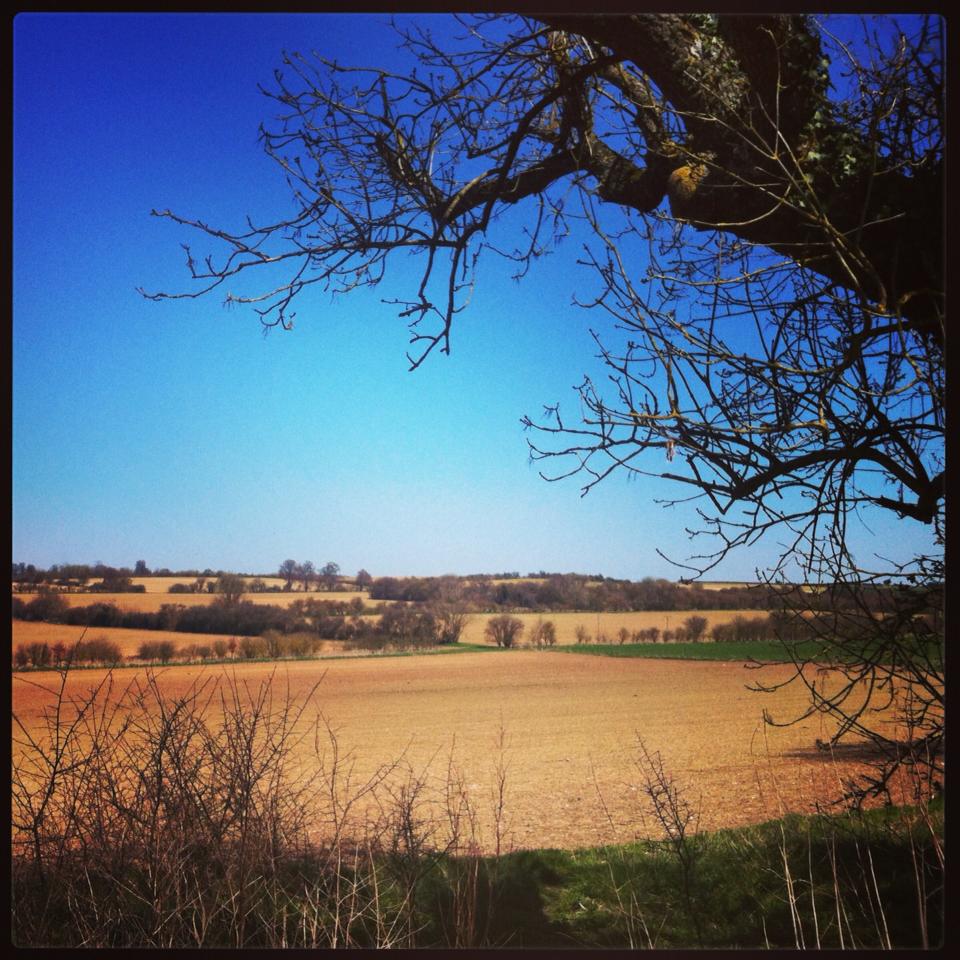
I took this picture yesterday in East Stratton, Hampshire. It was the inspiration for this story.

On Loss

Today is the funeral of a girl I know who tragically passed away in a car accident three weeks ago. She was just 32. Although I haven’t seen her for several years, I remember her as being beautiful, funny, kind and talented – she was an actress and, I recently learned, an aspiring playwright. I can’t imagine the pain her husband of two years is going through as he struggles to come to terms with the bottomless chasm of his grief – they were together since before I knew them, so he must feel he’s lost a part of himself. I just hope that one day he (and her family and friends) will be able to look back at the many happy memories they shared with fondness rather than pain, though I imagine that will take a very long time.

Being slightly removed from the situation by virtue of the time that’s passed since I last saw them, it feels somehow self-indulgent for me to wallow in grief. But I haven’t been able to stop thinking about her since I found out. It just seems so unfair that someone with such a zest for life, who showed so much promise in her career and was such an incredibly lovely person, should be so cruelly snatched away and cut down in her prime. I know the same could be said about everyone who dies young, I suppose this is just the first time it’s been someone who I really knew, and it’s come as a terrible shock because this is normally the sort of thing that happens to other people.

When I first found out I wrote a post about trying to take what little positives there are from such a tragedy, so I’m reminding myself now to make every day count, to tell everyone how much I love them and to be the best person I can be. But somehow all those promises feel like little more than hollow reassurances today, as I think about the fact a bright star isn’t with us anymore, and the sky will be a darker place without her in it.

I’m going to close with the poem I read at my grandma’s funeral years ago, by Mary Elizabeth Frye. It makes me cry every time but I think it’s beautiful:

Do not stand at my grave and weep,
I am not there, I do not sleep,
I am a thousand winds that blow
I am the diamond glints on snow
I am the sunlight on ripened grain
I am the gentle Autumn rain

When you awaken in the morning’s hush
I am the swift uplifting rush
Of quite birds in circled flight
I am the soft stars that shine at night
Do not stand at my grave and cry
I am not there, I did not die

Rest in peace, Katy. You may be gone, but you will never be forgotten x

I chose this picture for today because it was taken in one of the most peaceful places I’ve been, Taliwas in Borneo.

Doris

As the days go by he finds he mourns the passing of the time more than her. For this he bears such crushing guilt he is tormented through his every waking moment, sometimes even in his dreams. She was not, he recognises, an easy or a pleasant woman. Many a time he’d heard her referred to as formidable, cantankerous, nasty and mean.

But for all her numerous faults, she had been his mother; dark-skinned, curly-haired, thick-ankled Doris. No nonsense, take-dat-spoon-on-da-back-of-yar-legs-and-dat-be-a-lesson-to-ya Doris. He’d lived his life in a combination of fear and awe; fear of her anger at the world, which all too often manifested itself as anger towards him, and awe at her ability to cope after all she had been through.

It’s what she’d been through that made it hard for him to turn away. The people who gossiped in the street didn’t know, they took her at face value and never bothered to look beneath the surface. But he knew everything. Not that she knew he knew. He was only a small boy when he’d crawled under her bed, found the box with the photographs – and the letters.

In her native Jamaica, at the age of seventeen, Doris had been gang raped and beaten so badly that she miscarried her firstborn – his brother. Two years later, when she was heavily pregnant, her husband was murdered by the very same gang. It was all there in the letters, the heavy black scrawl of the condemned asking – no, begging – Doris for forgiveness. He never could bring himself to ask if she had granted her rapist – also her husband’s killer – the absolution he so desired.

He had simply allowed her to exert her grief on him.

Image

Thinking about a mother’s love for her son reminded me of my time living in a remote orphanage in Kisii, Kenya, in 2007. It was run by this lovely lady, Rebecca, and her husband Amos. They were the most wonderful hosts for the six weeks I spent there, and despite them speaking limited English we struck up a very warm relationship. Even though I sometimes found it so hard being there, I look back fondly on their family and the hospitality they showed me.