Hate for hate’s sake

I know I shouldn’t jump on the bandwagon after yesterday’s shocking attack on a soldier near his army barracks in Woolwich, but I’ve been so shocked and appalled by the outpouring of anti-Muslim sentiment on social media in its wake that I feel compelled to write about it.

What happened was both vile and unforgivable. But whilst the true nature and circumstance of the crime has yet to be revealed, let’s get one thing straight. Whether this was truly an ‘act of terrorism’ – as the media so gleefully report – or the act of two delusional individuals with extremist beliefs, it is beyond wrong to lay the blame for this incident at the door of the Muslim community.

For the English Defence League – whose website claims they are “are an inclusive movement dedicated to peacefully protesting against Islamic extremism” – to arm themselves with bottles and attack police and mosques in the wake of the incident is despicable.

Why do some people in this country – and the world at large – have such a strong propensity for hate? They claim to be fighting a cause but in reality it’s simply violence for violence’s sake. An eye for an eye is what they misguidedly believe, but do they even understand what they’re allegedly fighting for?

Yes, times are hard, and many people are looking for someone to blame. But for God’s (and by this I must be clear that I mean any god) sake let’s not lose the one thing that makes our species great: Our humanity. Because without that what are we but animals? And savage ones at that.

The plight of Rhinopharyngitis

The Common Cold (also known as nasopharyngitis, acute coryza and, my personal favourite, rhinopharyngitis).

Symptoms: Frequent sneezing; throat like sandpaper; obscene amount of snot flowing indiscriminately from nasal region; general fatigue and listlessness, decreased appetite for everything other than tomato soup and chocolate-based foodstuffs.

Incompatible with: Sleeping soundly; going about your daily life, exercising, being cheerful.

Cure: INCURABLE (to put this in context, there’s recently been talk of finding a cure for AIDS, yet the most common illness of them all cannot be conquered? Who are these scientists? And are they serious?).

Did you know that the average adult contracts two to three colds a year, with the average child contracting between six and twelve? Whilst not debilitating, colds have the ability to zap us of our joie de vivre, making even the simplest of tasks seem suddenly unbearably difficult.

It starts with a general feeling of malaise and exhaustion. You’re too tired to go for a run, to cook dinner, to meet friends for a drink. Even the thought of hanging up the washing leaves you drained beyond all reasonable measure.

Then comes the sneezing; huge howlers that catch you unawares on buses and tube trains, prompting all those in the immediate vicinity to turn away in disgust. You wander the streets like a leper, residing in the shadows with mouth covered and a grotty tissue clasped in your sweaty hand.

Your throat is scratchy and no amount of water, wine or hot Ribena (just me?) can quench your thirst. You catch sight of yourself in the mirror and feel certain Caspar the friendly ghost would envy your complexion. Even your hair is lacklustre.

You go about your tasks like an automaton; without enthusiasm. You begin to avoid people, conversation dries up. Your single waking thought revolves around your need to be in bed – alone, and with a box set of your favourite TV programme. You have, in the space of a few short days, become a virtual recluse.

If armies used the common cold virus against their enemies in war it would surely help them secure victory. Imagine a whole squadron of trained killers feeling a bit below par, having to stop every now and then to blow their nose or take some cold and flu tablets. Imagine the gains the opposition could make!

Put simply (and crudely-from the mouth of someone in the throes of one right now), the common cold sucks balls – big, hairy, snot-filled ones.

So there.

I’m going slightly against my picture rule today but thought I’d spare you a picture of my ghostly face and eye bags, and instead post a picture of the common cold itself. Pretty little blighter ain’t it?

Fight hate with love

Like many I was shocked and horrified to hear of the bombs that rocked yesterday’s Boston marathon, killing three – among them an 8 year old boy – and injuring many more. When I expressed my outrage at this latest tragic atrocity, however, I was shocked when someone challenged me to explain why it was any more tragic than the almost daily bombings in Iraq or Syria.

Ever since it was asked of me that question’s been playing on my mind in a loop – in much the same way as the video clip of the Boston marathon bombs going off has been played on every network since it happened. Did I feel more sad hearing about the marathon victims than when I heard news reports of innocent civilians being blown apart in Iraq? If so, what did that say about me? Was it possible some form of racism, classism or snobbery had crept into my consciousness without me even noticing its existence? Did I, in truth, value the lives of those people in Iraq less than the lives of the marathon spectators?

After a thorough period of introspection I’m pleased to say the answer to those questions was a resounding no. Whether they lost their lives in Boston or Iraq, I feel the same deep sense of sadness, the same feeling of shame that there are other human beings capable of such terrible acts of malice and hatred against their fellow men, women and children. The Boston bombings aren’t, therefore, more tragic; not at all. But, for those of us in the western world who are fortunate not to live in war torn countries, it is more shocking. Why? Because, quite simply, it’s far less common for a bomb to go off in the middle of a marathon taking place in an American city than it is on a normal day in an Iraqi city.

And there’s another reason. We see so many international news reports featuring the images of bloodied, limbless children’s corpses and wailing men and women beating their chests with grief that we are systematically desensitised to their effects. We’re used to death in Iraq and Syria. What we’re not used to is death in our own communities – or at least not the kind of death we witnessed yesterday in Boston.

No matter where terrorism strikes it sends shockwaves through not only the community whose beating heart it strikes, but also across the world. But whilst each time they strike the terrorists may think that they are winning the fight, what their hate-filled hearts will never comprehend is that through love for our fellow men it is we who will win the war.

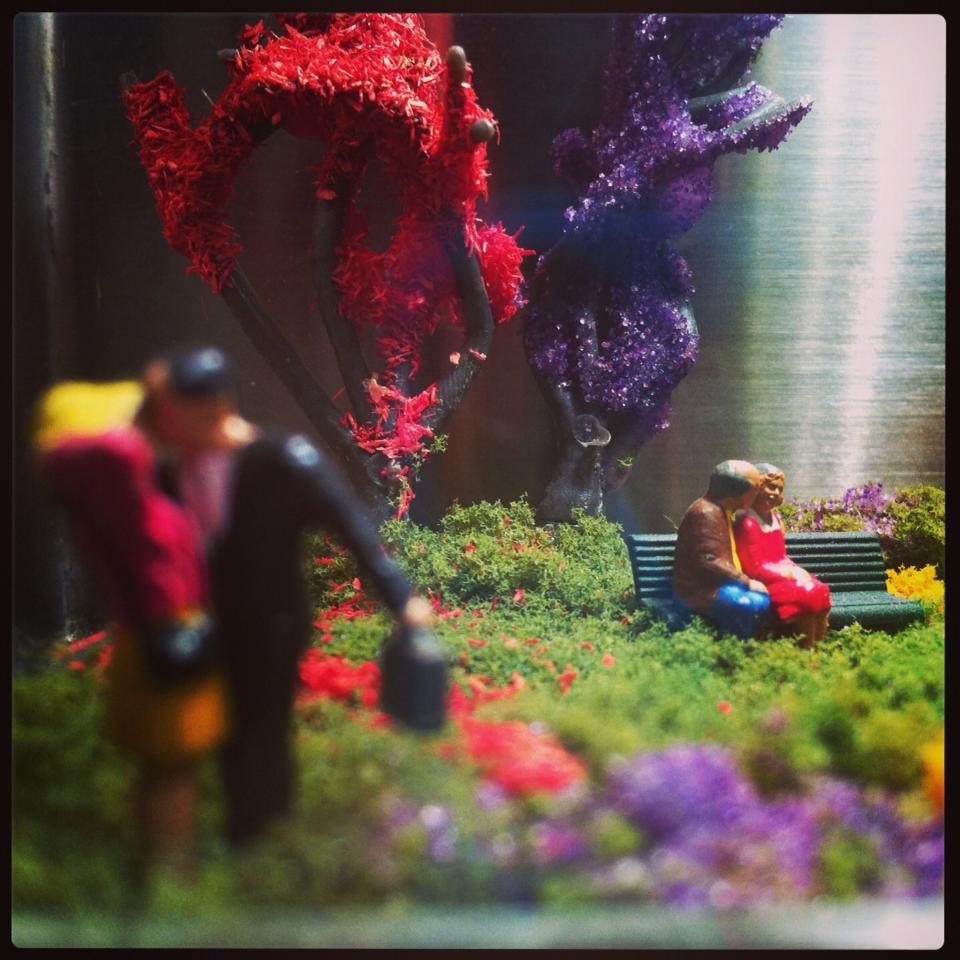
I fell completely head over heels with this, a tiny model scene in the wall of a toilet in a Manhattan restaurant. I think it’s quite appropriate given the end of today’s post.

Past Post: Laos

I wrote this last year when I returned from my travels and submitted it to a newspaper writing competition. Sadly I wasn’t shortlisted, but I do think it’s good enough to share here, so here it is.

When the minivan driver hit his second chicken and narrowly missed a child toddling by the roadside, I felt moved to intervene. “You’re driving too fast, it’s not safe!” He responded with a maniacal laugh and slammed his foot down harder on the accelerator. I sighed. This was going to be a long journey.

I have heard many travellers claim that the people of Laos are amongst the least friendly in South East Asia and, based on this experience, I might have said the same. But to understand Laos and its people one must first understand its history. When you consider the ‘Secret War’ waged against it by the US from 1964-1973 – during which over 260 million cluster bombs were dropped on a country with less than three million inhabitants to dent the spread of communism from Vietnam – it’s easy to see why distrust and contempt against foreigners may exist.

It is estimated that up to thirty per cent of cluster bomb units did not explode on impact, and to this day there are still thousands of unexploded bombs located throughout Laos, many of them nestled unobtrusively in paddy fields where ordinary farmers are trying to eke out a living for their families, and where they and their children risk life and limb every day as a result.

We passed through many such fields on our kamikaze minivan adventure from Phonsavanh to Vientiane. In my more lucid moments, I relaxed my grip on the seat and pondered what it would be like to meet some farmers and ask them in person what it was like to live under the constant threat of such unimaginable horror. Perhaps then I would get under the skin of the country I had previously – and shamefully – only heard of in the context of its popular tubing tourist attraction in Vang Vieng.

Tubing is fun, and arriving in the country on a slow boat down the Mekong River is an experience not to be missed, but both are essentially just part of the tourist trail. Even the Plain of Jars and nearby ‘bomb village’ lack genuine character, the touts having sucked it out with their sterile production-line tours. It doesn’t help that a lack of infrastructure makes getting around a strain for even the most hardy of travellers, particularly in the wet season when roads can be impassable due to flooding.

My lasting memory of the country won’t be floating down the river in an inflatable tube, nor wandering around a field of ancient, unexplained relics. It won’t even be the suicidal minivan driver or the touts and their soulless tours. It will be the ordinary but heart-warming sights I witnessed as we drove for hours along death-defying roads; bright eyed children playing and whole families working the bomb-littered fields. Whilst such glimpses by their brief nature fail to yield any real insight into the Laos Peoples’ character, I will always feel respect for them, going about their business despite all that has been inflicted upon them.

Image

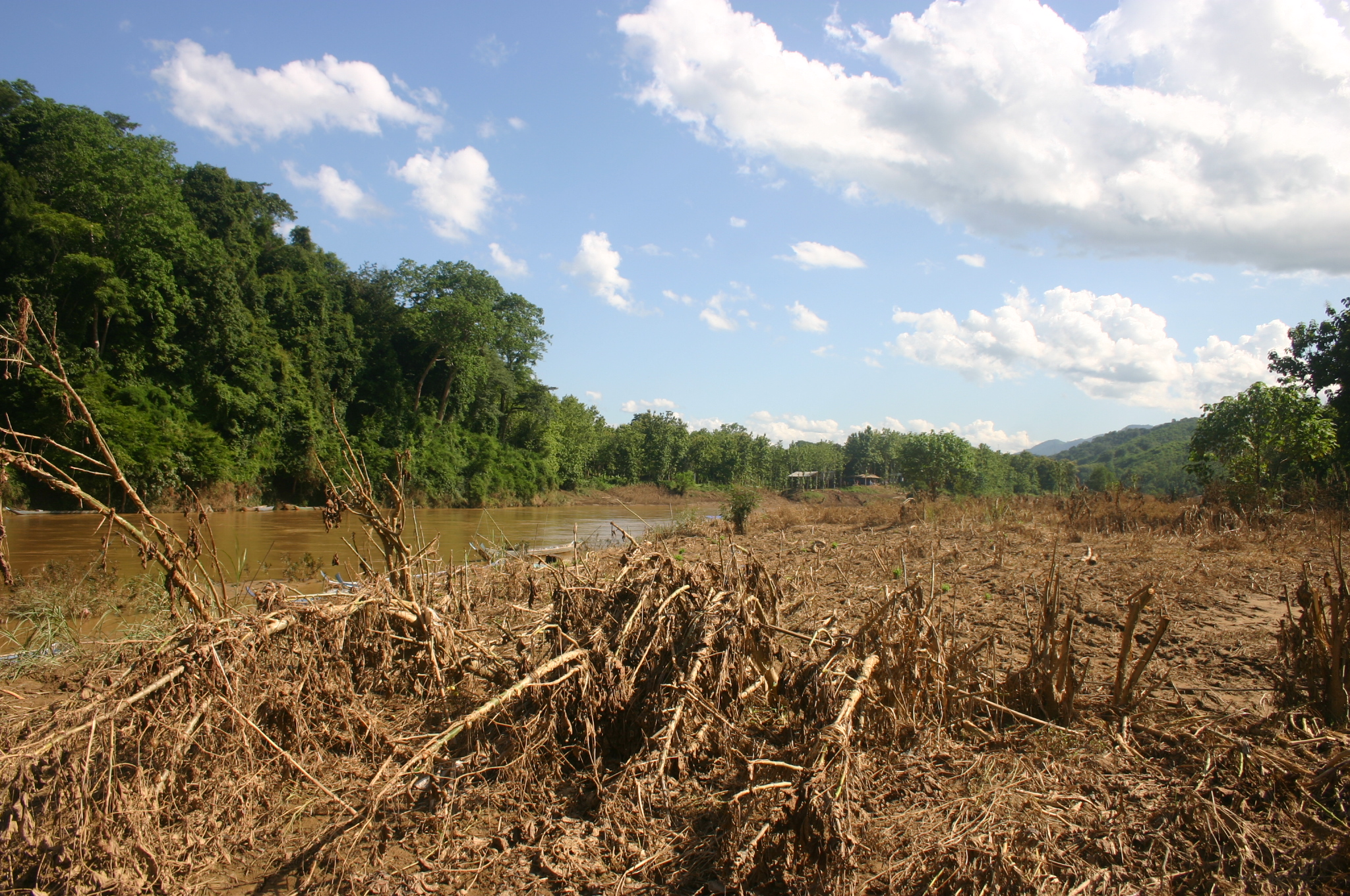
I took this on a day trip from Luang Prabang to a stunning waterfall, and was struck by the contrast of crisp, brown landscape and bright blue sky.