5 Ways to Beat the Winter Blues

Anyone who tells you they don’t feel a bit more crap than usual in January is either lying, or is an alien from the planet Zog (you want to watch them). Trust me. The post-Christmas slump (when your body finally holds you accountable for going entirely off-piste where its wellbeing was concerned for the entire month of December), coupled with plummeting temperatures and a severe lack of sunlight leads to a collective form of exhaustion tinged with malaise – a nagging but non-specific feeling of ‘what now?’ We try to shake it off and kick start the year with enthusiastic resolutions like: “I must eat less!” “I must exercise more!” “I must work harder!” “I must take up that hobby!” Ad Nauseam. But by the end of the month those who started dry January are tearing out their eyeballs and those who didn’t are checking into rehab.

Those of us who live in places that experience prolonged spells of cold and dark each year employ various coping strategies to get through them with our sanity intact. Some choose to avoid it altogether by booking a one way ticket to Australia (and who can blame them?) But for the majority this isn’t a feasible option, so we stock up on Vitamin D tablets and sun lamps (well, those of us that can be arsed do – can’t say I’m one of those people), book holidays to warmer climes to titillate our ailing imaginations (guilty) and let every nanosecond that the sun succeeds in elbowing its way through the thick nimbostratus clouds be reason for unbridled celebration (after all, it is nearly spring, sort of). And for the rest of the time we pull our woolly hats down over our ears, slip our chilly fingers into gloves and leave the house each morning, in the dark, with grim determination etched across our faces.

But there is hope. In the wealth of personal experience I’ve gleaned through the endurance of numerous winters, I am now in a position to share with you a handful of things that really can alleviate the symptoms of this gloomy time of year:

  1. Read a good book – by which I mean a book you enjoy so much it’s like having a love affair; you want to be with it every moment of the day, and can’t stop thinking about it even when you are apart.
  2. Have a lot of baths – soaking in hot water with scented bubbles really does melt your worries away. The deeper the bath and the longer you spend in it the better.
  3. Do guided meditations every day when you wake up – I’ve recently discovered these ones from the Chopra Centre in California, and I find it helps a lot to take a few minutes after waking to focus on breathing in the context of which ever topic you have chosen.
  4. Keep a daily morning journal – as advised by Julia Cameron in The Artist’s Way. I’ve struggled with this a lot over the past couple of years because I often tell myself I’m too exhausted to write as soon as I wake up. But after a hiatus of a few months I have today started again, because I’ve noticed the difference in my stress and creativity levels since it last tailed off.
  5. Live life more mindfully – this is one I struggle with on a daily basis. There are always so many distractions that it’s often hard to create space to observe and appreciate the minutiae of life. Last year I did the #100HappyDays challenge which involved taking pictures each day for 100 days of something that made me happy. And you know what? I found I was being a lot more mindful – always looking around for something beautiful, striking or inspirational. That’s why I’ve decided to start my own #MindfulnessMonth – every day in February I will document, by way of image, blog or both, something that I have taken the time to stop and appreciate.

Those are my ways of coping with the winter blues. Good luck finding yours.

winter-blues

New Year Musings

It’s with a surprising degree of trepidation that I return to Brussels today after the Christmas break. With hindsight I think the first eight weeks of our life abroad were made easier by the fact of our imminent return, whereas now I have no such trip back to the UK planned to anchor me here it feels somehow more final. Which is of course so very silly when you consider that it only takes a little over two hours to get from Brussels to London-the same time as a trip to Manchester, no less. I guess it’s especially hard to return anywhere after spending the festive break catching up with friends and family and having such a wonderful time. The past two weeks have been ridiculously busy but enormous fun and I’ve loved every minute. But life can’t be all about the parties and family time. If it was we wouldn’t appreciate it half as much when we do get a chance to enjoy it. So enough of the sentimentality. I know once I’m back in our gorgeous flat I’ll settle back into the routine in no time.

I’m not a fan of new year’s resolutions as I think people all too often set unrealistic goals and in doing so set themselves up for a fall. But having said that I do feel a sense of optimism about 2015. My goals are simple and, I believe, achievable:

1. Make writing a daily practice again, even if only for 15 minutes each day. Discipline is everything where writing is concerned, so this is non-negotiable if I really want to achieve my writing ambitions for 2015 (finish screenplay, get back into short story writing, start new novel).

2. Make meditation a daily practice again, even if only for 5 minutes each day. Mindfulness is such a valuable way to still the mind, reduce anxiety and help focus on the ‘bigger picture’. When I practised meditation daily in India I reaped the benefits, and I want to get back to that calm state of being.

3. Exercise regularly. This one sounds so simple, but as someone who one year ago was training for a marathon and who now can only comfortably run about ten metres for a bus, I’m acutely aware of how easy it is to lose fitness and get stuck in a rut of no exercise and low self-esteem as a result. My own inactivity has in large part been due to the prolapsed disc I unfortunately gave myself through overtraining for the Rome marathon (which I was subsequently forced to pull out of), but it’s been months now and I’m physically quite ready to get back on the horse. The only thing stopping me is my own fear and laziness, so a new year is the perfect time to kick those inhibitors into touch.

4. Make time for reading. As a writer this one seems obvious, but all too often reading is something that gets relegated behind a million and one other things each day, whether it be cooking, washing, ironing, watching TV, writing-the list goes on. The only way I will get better as a writer (which I certainly need to do) is to improve the breadth and scope of the materials I read. Not only that, reading others’ work is refreshing and inspiring, not to mention relaxing (there are few nicer feelings than being swept up in a story you never want to end). So this is my final goal for 2015. I don’t have to read every classic ever written, but I do have to make a concerted effort to read something every day. I know my mind will feel all the better for it.

Having set those goals out en route to  St.Pancras station it seems fitting that I’m now waiting to board the Eurostar and continue the adventure that began some ten weeks ago. Who knows what this year will bring, all I hope is that my loved ones stay well and happy and that I do myself, and them, proud in whatever ways I can.

Happy New Year to you all from this wandering muser. May 2015 bring you one step closer to your dreams. Xx

image

Recombobulation

In the past five and a bit weeks life has undergone a pretty big transformation, so I suppose I shouldn’t be surprised I’ve hit a bit of a wall where energy levels are concerned. I’ve moved country, moved house not once but twice, and started a new job in a new country where the employment system is more complicated than the Matrix. Not to mention the fact I’ve gone back up from working four days a week to five, which in itself is quite a shock to the system (I’d be lying if I said I wasn’t mourning my Mondays off – sniff). So yes, I guess I need to cut myself some slack, as my transatlantic friends would say. Getting into a new routine takes time, especially when the repercussions of that new routine involve a run of terrible nights’ sleep that leaves you feeling like your head is full of cotton wool.

Oh, and did I mention that good old Lady Karma has bitten me hard on the arse for boasting about my amazing new flat by sending me the neighbour from hell who appears to have no concept of bass control on his/her stereo, nor a concrete understanding of the less than concrete thickness of the wall that separates our living rooms. But hey, these things are incidental, and they shall pass. I just hope they pass sooner than later, because I need to get back to writing my screenplay and setting myself on the path to making the millions I need to be able to give up working for someone else and start setting my own agenda in life…A girl can dream (or at least she would if she was actually getting any sleep at the moment…Grumble grumble).

discombobulation

Tat’s Life

I’ve been fascinated by tattoos for as long as I can remember; intrigued by the stories they tell, by their boldness and their permanency. I had my first one done around the age of nineteen, and whilst I can’t say it was the most profound of experiences (if I recall correctly I’d imbibed at least two pints of cider after a university lecture and had dragged my reluctant friend to the tattoo parlour with me intent on getting a dragon on my hip, but when we got there and they didn’t have any dragons in the book I opted for a four leaf clover instead – lucky I’ve never regretted it. But then, how can you regret luck?), it set me on a path of discovery that I’m very much still following today.

Each tattoo since that first one has held more emotional significance. The second, a literal translation of ‘inner strength’ into Cambodian script on my lower back, was done after a long term relationship ended badly in 2007, and I wanted to mark the start of my recovery by remembering the happy time I had spent alone in Cambodia before news of my ex’s infidelity broke. The next one came along after a stint of travelling in 2011. Written in English on my foot, it is the last line of a Buddhist prayer (‘May all beings be free), the full version of which my parents kindly gave me as a talisman on a necklace before I commenced my travels. On that trip I had a magical experience with a green turtle whilst diving in the Perhentian Islands off the coast of Malaysia, which I felt was relevant to the last words of the prayer (and hence also to the meaning of the tattoo). I also happened to meet the person I sincerely hope to spend the rest of my life with, who makes me feel more free to be myself than anyone I’ve ever known.

And then there’s the newest addition to the tattoo clan. I’ve been toying with this one for a while, and it’s been particularly difficult because it is related to the thing I’ve struggled most with for the majority of my adult life: Writing. Some of you may know I went part time a year ago to focus more on my writing, but due to a severe lack of discipline on my part, ‘success’ (whatever that means) hasn’t materialised in quite the way I’d hoped it might. So I’ve recently decided to take off some of the pressure, to try and write ‘for love’ instead of fame and fortune. And to help me both with my writing and with the new transition I’m about to make to life as an expat in Brussels with my partner, I decided one more tattoo was appropriate – this time the unambiguous word ‘Believe,’ written as if by a feather quill, which is also included in the design, and which stretches over onto the top of my arm.

I’m sure none of my tattoos will be to everyone’s taste, but all that matters to me is that they are to mine. Not only that, each one (with the exception of the clover, but I love it nonetheless) marks important stages in my life – beginnings, endings, declarations of hope. Each to their own, I say. Maybe I will be embarrassed by them one day, when I’m old and wrinkly and they no longer look as good as they once did. But, like my wrinkles, my tattoos will go to the grave with me, and they will tell the story of adventures, of love, of aspiration: They will tell the story of a life well lived.

1489575_10154618013850057_8476868507490787558_o

The Word is Out: Onwards and Upwards

So, it’s official: Five weeks on Saturday I’ll be moving to Brussels. Why? Because my other half’s job is taking him there, and also because I know enough about both life and love to know that when opportunities come up you have to follow them – as well as your heart. To say I’m terrified would be an understatement, but the overriding feeling is one of excitement. I’ve lived in London for the past twelve years, and whilst I love this crazy, vibrant city and will miss it – not to mention all my friends here – more than I can say, I feel ready for a change.

Whilst ‘what will I do’ and ‘where will we live’ are pretty high up on the list of burning questions, ‘will I write more when I’m away from the distractions of London’ is the one that’s really running on a loop through my mind. It’s no secret that reducing my working hours by one day a week to give me time to write has been less successful than I’d hoped. But you know what? After a lengthy hiatus I’ve started meditating again and I’ve done some thinking, and have decided that it’s time to stop beating myself up for what I haven’t achieved, and start taking steps – no matter how small – towards what I am capable of achieving. That may be a published novel, or it may not, and for the first time in a long time I can honestly say that I’m okay with either. My new plan is to ease some of the pressure I’ve been putting on myself and fall back in love with writing, hopefully at the same time as I fall in love with the new city that is to become my home for the foreseeable future – and I’m excited.

Life is for living and the world is for exploring. And whilst Belgium might not be all that exotic, or, in distance terms, all that far away, it’s certainly a start.

motivational-quotes-through-week--large-msg-13523186561

On Writing Autobiographically

During last night’s crime writing class at the City Lit we discussed characterisation. I told the group I was intent on making the protagonist of my latest story as unlike me as possible. Why? Because I’ve realised that, all too often, I write characters as if they were, in fact, me, and whilst Polly Courtney said at last week’s Writers’ & Artists’ conference that most people write their first novel autobiographically (“because they have something to get off their chest”), in my case I fear it might be more to do with laziness than self-expression. I worry that in writing characters who are based, no matter how loosely, on me, I’m closing myself off to a host of far more interesting and complex characters. Not only that, I’m failing to examine their personalities thoroughly enough to be able to fully inhabit them, as I’m assuming they would have the same thoughts and feelings as I would, when this isn’t necessarily (and indeed shouldn’t) be the case.

After a written exercise, wherein we were encouraged to introduce our characters by name (“My name is X…”) and elaborate on how they felt about that name, whether it had any connotations/associations etc., we had a group discussion. One of my fellow students said she didn’t like the character she had written about in the exercise – in fact, more than that, she actively disliked her. The teacher was concerned about this, and said that if a writer is unable to empathise with their protagonist they must at least be able to foster a sense of curiosity about them. For example, what experiences have shaped them into the person they are today (or at the time your novel is set)? Why do they hold certain viewpoints and like or dislike certain things?  

A useful exercise in characterisation, we learned, is to take your main character and write about them both ‘from the inside out’ and ‘from the outside in.’ In other words, write one paragraph ‘as’ them (a letter to a loved one, for example) and then answer a series of questions ‘about’ them (e.g. what is their favourite colour/food, what do they like/dislike etc.). One particularly pertinent and often revealing question is ‘What does he/she dislike most about him/herself,’ as it often gives rise to useful insights into their inner psyche.

The lesson, I suppose, is that if you don’t completely identify with your main character that’s fine, so long as you like them sufficiently to be curious about who they are and what makes them tick. What is certain is that during the creative process you’ll be spending a huge amount of time with this person, so it has to be someone you’re happy to hang out with – or you’ll likely have a pretty miserable time writing it!

character_profile_girl

For Fellow Aspiring Writers: Advice from the Writers’ & Artists’ Conference

On Saturday I went along to the Writers’ & Artists’ ‘How to Get Published’ conference in Euston. Given my aversion to early rising it was quite a commitment for me to show up at 9.45am on a weekend, but by the end of the day I was so glad I had. I live-tweeted throughout the event but it has since dawned on me that advice drip-fed through Twitter isn’t that easy to come back to afterwards. So for all my fellow aspiring writers I thought I would encapsulate the key learnings in this blog post for reference purposes.

Tom Tivnan from the Bookseller, on self-publishing:

  • 86% of those who have self-published would do so again
  • The print self-publishing market is comprised almost entirely of non-fiction
  • Most self-published e-books retail at around £1
  • 69% of e-books are bought by women and only 11% by men
  • 58% are published by women
  • Crime makes up 50% of the e-book market
  • Amazon controls 75% of the e-book market in the UK
  • The royalty rate of self-published books decreases considerably when the retail price is below £2.49
  • When self-publishing, tweak the price of your book often
  • Remember that people buy e-books for price not content
  • Design matters – it’s all about your brand
  • It’s difficult to get into the print market through self-publishing (Amazon has 20% share)

Stefan Tobler, CEO of And Other Stories, an “unashamedly literary” publishing house:

  • “Think of the publisher as the donkey who will get your riches to the reader”
  • The literary fiction market is in decline

John Mitchinson, founder of Unbound, a ‘new way of bringing authors and readers together’: 

  • The concept of Unbound is “about sharing an idea, sharing the potential of the story and, if there is enough critical mass, it will take off”
  • “Publishing is like agriculture. Retailers want the crops with the highest yield and won’t look at anything else”
  • Authors have a 1 in 5,000 chance of getting in with a big publishing house – but there are other ways to get published
  • It’s been in the news recently that the average author’s salary is as little as £11k per year but, f you take the top 10% of authors out of that, the average author makes less than £3k per year.
  • “We’re fighting to keep people reading”
  • Unbound chooses the projects with the best chance of funding
  • People can then make pledges against a particular project. The average pledge value is £35
  • 92 projects have been launched to date. Of those, only 16 failed to achieve funding
  • Unbound has 48k registered users

Polly Courtney, Author, on self-publishing to a traditional deal – and back again:

  • “Everyone’s got a book inside them, but not everyone should publish it”
  • “Whatever way you’re publishing, be sure to build up your own direct fan base.” e.g. by capturing email addresses through cards slipped into the back of your book at a launch event
  • Re-write extensively
  • Never scrimp on cover design
  • Self-publishing CAN work – but it’s all about collaboration
  • For a lot of people the first book is semi-autobiographical. Once you’ve got that off your chest you’re free to write about something else e.g. a theme you particularly care about
  • “If you do get into a conversation with an agent or publisher, ask what their long-term vision is for you and your book. Make sure you understand one another – it’s not arrogant, it’s sensible. Take control of your destiny”

Alysoun Owen, Editor of the Writers’ & Artists’ Yearbook, on traditional publishing:

  • “Finding an agent or publisher is like buying a car – you wouldn’t buy one without finding out about it first”
  • “Be yourself and write the book you want to write”
  • Good things CAN happen to first time writers
  • Identify the market and identify your niche
  • If you can’t encapsulate your story in a 200 word pitch, why should anyone else look at it
  • Self-publishing has gone up by 25% but the lion’s share of the (admittedly plateaued) market are traditionally published books
  • Rejection is not an uncommon thing – all the best authors have been rejected (William Golding 21 times!)
  • Things to do to improve your chances:- Read, Read, Read
    – Research / know your competition
    – Join a writer’s group / attend events
    – Practice e.g. by entering competitions
    – Promote yourself e.g. on Twitter, a blog etc.
    – Be patient
    – Be ambitious

Charlie Campbell, Agent:

  • Agents can tell if they’re the first or two hundredth you’ve submitted to, so research carefully before submitting
  • The bar has been raised, so these days agents need to put more editorial work in
  • Having to do too much editorial work limits how much work you can take on
  • When working in a big publishing house out of thousands of submissions each year, only one or two would be taken on
  • “Sending a partial manuscript is almost never the right thing to do”
  • Writers get rejected by agents, agents by publishers, publishers by supermarkets. If Amazon rejects a book, the reader rejects it
  • Successful stories are imitated until they dwindle into nothing. Do what you want but don’t be too out there. It’s the role of the publisher/agent to talk to you about how you can progress

Jo Unwin, Agent:

  • Take care to read submission guidelines and be targeted
  • “You can only be a debut novelist once in your life, so your manuscript needs to be as good as it can be”
  • “I would strongly recommend getting the whole book as perfect as you can before submitting your opening chapters. It’s a different trajectory if you submit a partial manuscript and don’t complete it for another 18 months. The market will be different and the mood of the agent will be different”
  • Whether an agent likes your book or not is a chemical thing. Writing is a craft you have to work on
  • What an agent does in building a writer’s career outside of the UK market is not to be underestimated
  • “In a synopsis I’m looking for storytelling ability, so tell me everything – including the ending”
  • Don’t use the agent as a sounding board – think of them as sales people

Cressida Downing, Editor:

  • Just because you can hit submit doesn’t mean you should, and just because you should doesn’t mean you should now
  • Whether sending to agents or self-publishing make your work the best it can be. People should find your writing frustrating
  • You can’t be a good writer if you’re not a good reader
  • “I read non-stop, all day, every day – and so should you”
  • Self-publishing is ideally suited to people with an entrepreneurial spirit
  • Novels go through 17 edits, on average, before they are successful in being published
  • Good presentation is crucial – get advice but don’t get someone else to re-write it or it will be their work and not yours
  • If you’re interested in money don’t be an author or work in publishing!
  • If you’re self-publishing and can only afford to invest in one thing, make it the cover design
  • When choosing an editor consider their track record, whether you would prefer to be edited by a well-known author or not, whether their style will fit your work, whether they offer a clear explanation of the service they provide, their costs and timings
  • Tips for going it alone: Never publish your first draft, always get someone to have a look, read it out loud and find a peer group
  • Self-publishing is about far more than writing a book and hitting ‘publish’
  • As long as you know what you’re asking and they tell you exactly what they’re providing, paying an editor can be useful
  • If everything in your story is doing it’s job, great. If not, cut it
  • There are four types of edit:

1. Read and Review

“If you pay one industry expert once in your life make it for this.”

Not a line by line edit, help with grammar/spelling or re-write (though they will say if it needs work in those areas).

Does give advice on how to avoid common pitfalls, how well your book is working and what to do to improve it.

2. Deep Structural

Most similar to advice from an agent or editor in a publishing house.

Doesn’t give line by line re-write and won’t correct spelling/grammar.

Does break down and re-build novel – sometimes to extent of changing genre or structure.

3. Copy

Line by line edit looking for continuity and what works to best show off your prose.

Doesn’t look at structural/major changes.

4. Proof

Picks up errors, typos etc. in spelling/grammar.

Doesn’t give advice on writing.

Preena Gadher, Publicist:

  • A publicist’s job is to make your book stand out from the crowd
  • Once you’re published by a house they’re invested in you and can afford a dedicated PR person. That’s the big difference between traditional publishing and self-publishing
  • Promote yourself with a website, on Twitter etc. Always keep sites up to date
  • Read the paper and magazines you want to appear in
  • Work out who your audience is, and what you have to say that would be interesting/relevant to them
  • The relationship with the publicist works both ways
  • It helps to be shortlisted for / win prizes

Laurie Penny, Blogger:

  • Being time-rich and cash-poor is how a lot of creativity comes about
  • Keeping a blog is good training for editing your work

Hope you will find this as useful as I did.

image

On Being Overwhelmed – and Finding Perspective

For the past couple of weeks I’ve been doing my typical headless chicken act, heaping unnecessary pressure onto myself with an extra -large spoon and wondering why I’ve been feeling totally overwhelmed and unable to write a damn thing in what little free time I’ve managed to carve out for myself. The culmination of this stress was evident when I got around to submitting the one piece of recent writing I was really proud of to a competition on Monday – only to realise that the deadline was midnight the night before. Fortunately my super-pragmatic boyfriend was on hand to prevent me falling too far into a slough of despond over the incident, but nevertheless it made a further dent in my already damaged armour.

The truth is, whilst I established long ago I want to be ‘a writer,’ I grapple every day with what sort of writer I want to be. One day I’ll write a magazine feature pitch, the next I’ll plan a novel or start editing a previous story. Then I’ll turn my attention to short story competitions and try to churn something out for them.  On top of that I’ve recently completed an eight week sitcom writing course at the City Academy, and have this week embarked on a seven week crime writing course at the City Lit and signed up for a conference next weekend on how to get published – all this as well as holding down a job four days a week. Oh, and did I mention I’m also working on a screenplay idea with my writing mentor?

Just reading that last paragraph back makes me feel anxious, it’s no wonder I’ve been feeling overwhelmed. But what I’ve realised today, after having given myself a couple of days’ downtime (by which I mean no pressure to write anything, having impromptu catch ups with friends, sitting in the sun at lunch time instead of being hunched over my computer fretting about what to write and yet still not writing), is that when it starts to feel too much that’s generally because it is too much. It won’t help to try and force yourself to do more, the only thing that will work is to allow yourself to do less. Only then can you regain perspective and control over your situation. And, in my case, only then can I remove the creative block that undue amounts of pressure create. This realisation has made me feel instantly calmer, and you know what? I can feel the ideas start trickling back into my brain just like a tap that was turned off has been turned on again. Perspective isn’t always easy to find when you’re mired in the mud, but when you do find it again it’s both a joy and a relief. Phew.

Riding the Hamster Wheel

Quote

After the success of my sitcom writing course (writing a 15 minute script and having it acted out by a Game of Thrones actress does count as success, right?) with the City Academy I have once again grasped the nettle and signed up for a 7 week summer course in crime writing, this time with the City Lit. This will run concurrently with the screenplay idea I’m working on with my amazing writing mentor, so I’ll have lots to keep me busy!

You see, what I’m coming to realise is that being busy is always best – or at least that’s the case with people like me, who are creatively minded and enthusiastic but tend towards laziness and phases of paranoid inactivity. Deadlines are key to productivity, and without concrete plans (submit essay by x, write plot outline by y) it’s all too easy to drift out with the tide, never to return to shore. So whilst I will quite often bitch and moan about not having enough hours in the day, I know deep down without these goals and targets I would lack the momentum to achieve anything at all.

Discipline, however, is a different beast entirely, and one that’s far more difficult to tame. You can set all the goals and targets that you like, but if you don’t ‘show up’ regularly, as a good friend recently said to me, the game is lost. And the fact remains that whilst I’m full of good intentions and prone to bursts of fervour, showing up regularly is still something I struggle with. That, and the idea that you don’t have to be in the ‘right’ mood to ‘write,’ nor even must you know where the writing will take you. You just have to sit down and do it. No but-I-have-to-hang-out-the-washing-then-go-to-the-gym-and-make-dinner excuses.

And on that note, I’m just off to the gym and to make dinner before I sit down with my laptop for the evening…..

image

P.M.A*

In recent weeks I’ve felt my old nemesis stress creep up on me. This was, in part, why I took the decision to have a week’s ‘staycation’ last week. And, as I sit here on the eve of returning to work, I have to say it’s done wonders. Not only have I achieved lots of my writing goals – the other reason for my taking some time off – I have also created some much-needed thinking and breathing space. It’s frightening how hemmed in you can feel by life if you don’t do that from time to time, and as someone whose standard response is to run away when the going gets tough – usually by going off travelling every three years or so, when the daily commute gets so much I feel murderous – I’ve been delighted to realise that the mental peace and clarity I’ve been searching for aren’t always that far afield.

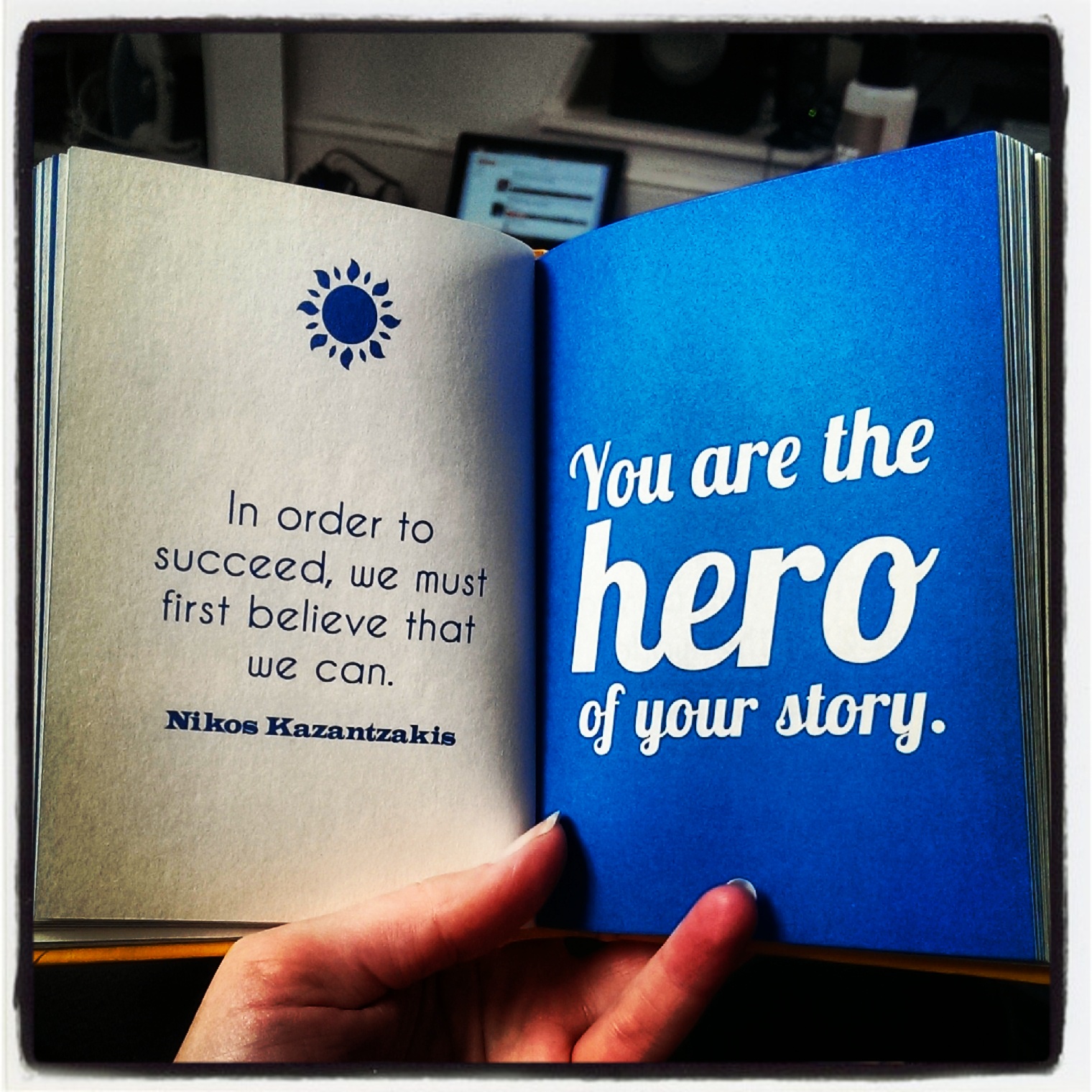
I’m writing this post because I want to hang on to this feeling of positivity, and to be able to refer back to it when I inevitably have moments of sinking back below the mire. I’ve also just been leafing through a little book called ‘Carpe Diem-Make the Most of Life,’ which was lent to me by a good friend and which is full of uplifting and inspiring quotes. Despite being a pessimist by nature, in moments like this I realise how wonderful life is, and what a monumental waste of time it is to be negative. As the page in the photo rightly says, ‘You are the hero of your own story.’ And nobody likes a negative hero, right?

image

*Positive Mental Attitude