Past post: The resurgence of swing

With the introduction of programmes like Strictly Dance Fever on mainstream television, styles of dance from bygone eras have been brought to the forefront of society’s consciousness.  And with so many swing organisations running successfully in the UK and abroad today, it begs the question:  Is the revived interest just a phase, or has the phenomenon been here all along?  Furthermore, is the interest confined to the older generation who want to relive the dances of their youth or a younger crowd who feel compelled to try something new?

Perhaps the best place to start is with the origin of popular swing dances from the first half of the century.  Typically black jazz dances such as the Charleston and The Cakewalk became more main stream in the 1920s and gave rise to the Lindyhop, which, in turn, evolved into the Jitterbug and Jive in the 1940s and 1950s.  Along with developments in the style of dance there were changes in the accompanying music, from big band swing music in the 1940s to rhythm and blues and rock and roll in the 1950s.  Popular artists of the time such as Glenn Miller and Little Richard took swing to new levels, helping to secure its place in musical history.

It wasn’t all about the music, of course.  Swing’s meteoric rise to fame was helped in no small part by the war, when military or civilian service meant people of all social ages and groups mixed on a regular basis.  The Jitterbug spread widely across the country during this period, and its exposure was not limited to the UK.  Swing was soon a global phenomenon, and has remained so ever since, albeit on a smaller scale than at the height of the war.

But how have swing dances survived?  Or more importantly, what has kept people interested?  Robin Weathersbee, who co-founded Maddy’s Jiving School with his wife, attributes swing’s longevity to the power of the music, claiming that “the strong rhythms and ever-popular ‘classic’ tracks, which still get mainstream media exposure today, have kept the music and style of dancing in the public eye.”

Martin Ellis, founder of Swingland, an organisation providing weekly swing dance classes, workshops and club nights, further strengthens the argument that swing’s success lies in its originality; “Over the last hundred years or so we have been able to record music, which means that we can trace the roots of every style of music, making it increasingly harder to produce something original.”

So who actually attends swing classes today?  According to Robin, most of his students are “much younger than the generation who would have danced to swing during the ‘40s and ‘50s.”  Martin agrees, “We have all age groups taking part, from young people in their twenties to older people in their seventies – but the vast majority are in their twenties and thirties.”

This revelation may come as a surprise to many, but Martin explains why younger people find swing classes so appealing; “Although our younger participants enjoy pop and rock music and go to clubs just like anyone else of their age would do, one fairly common theme is that none of them are into the seedier side of clubbing, such as drugs.  They enjoy going to an environment that is not fuelled by that, as its all about the music and dancing.  I suppose you could say it’s more wholesome.”

It would therefore seem that the perception of the swing culture as a safe alternative to modern day forms of entertainment may be another reason for its prolonged success.  This theory is given more credence if we consider the fifties lifestyle.   People had less disposable income to spend on drinking and leisure pursuits than they do today, meaning the emphasis was on cheap forms of entertainment such as dancing.  Society was just beginning to recover from the war, and dancing must also have provided a welcome release from the oppression of previous years.

So are television programmes like Strictly Dance Fever responsible for the recent resurgence of swing?  “Television programmes are not necessarily the reason,” says Martin, “The swing scene in the UK, compared to the US and Europe, is not really about competition, so whilst such programmes do bring exposure they don’t generate a huge interest.  It really comes down to the fact that the music is very good and the dances, although not easy to learn, are addictive once you have picked them up.  There is also such a big scene worldwide that many people see it as a chance to go travelling and meet other like-minded people.”

For many, the interest extends into other areas of the fifties lifestyle.  Robin and Collette Weathersbee are a perfect example.  “Our interest started with the music of the era, but we now collect and wear vintage clothing, own a 1947 Plymouth convertible car and have furnished our home in period style,” says Robin.

Whatever the reason for the interest, it seems the swing culture is alive and well in today’s society, both in the UK and abroad. And long may it reign.
7028_317306540056_4768498_n

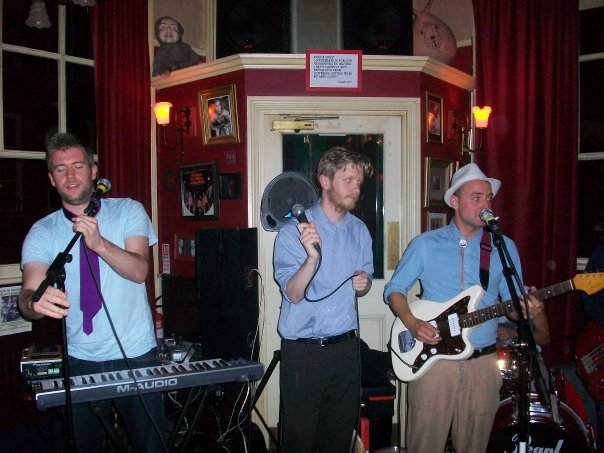
Writing this post reminded me of when my friend’s band played for my 29th birthday celebrations in a pub in Vauxhall. It was such a fun night!


Welcome to a runner’s worst nightmare…

When my alarm went off at 6am this morning I was unimpressed (to say the least), and wondered momentarily just how bad it would be if I didn’t turn up to the Wholefoods run I’d spent the last ten weeks training for. But I somehow managed to peel myself out of bed and get my stuff together in time for the 7am taxi pick up.

As we drove towards Kingston I was naively optimistic that the weather may not be as bad as predicted after all, but by the time we pulled up in the market square the snow was falling and it was nothing short of freezing. Clusters of runners stood in every doorway, huddled together for warmth and staring at one another forlornly whispering, ‘why are we doing this again?’

By the time the 16 mile race started I could no longer feel my fingers and was starting to doubt my ability to complete the race (never a good thing at the very beginning), but before I knew it the horn had sounded and we were off. Once my body temperature began to rise I settled into a comfortable stride for the first eight or nine miles, quite enjoying the scenic part of the route beside the river (less so the rather more grim road section).

By mile ten, however, I was struggling – badly. The cold had crept into my bones and my hip joints were so sore I felt like a 90 year old. I’ve never felt pain like that in my hips before (in all of my training runs they’ve never so much as ached – mind you, if it was ever below five degrees in my training runs I tended to exercise in the gym. Oops) and was unsure what to do, so I slowed down for a couple of miles to try and ease the pain. When I realised it wasn’t going anywhere I changed tack and opted to run as fast as I could manage until the finish line, figuring I could at least then stop and rest.

Fortunately the strategy paid off and through gritty determination, sheer bullishness and an inordinately large amount of sugar-based stimulants I made it across the finish line – in a respectable 2 hours and 31 minutes and 29 seconds. I had hoped for a sub 2:30 time, but given the horrendous conditions I’ll let myself off.

It’s a miracle I’ve managed to drag myself to the computer to type this given how much pain I’m now in – walking up the stairs feels like as big a challenge as climbing Mount Everest right now, but it was worth it (I think). If not for the glory of completing the race, then for the huge amounts of roast lamb and chocolate cake I was treated to by my parents afterwards 🙂

Important lesson for next time (yes, I’ve already signed up for another race – this time a half marathon, Run to the Beat, which is at least in September so can’t possibly be as cold as it was today. RIGHT?): Train outdoors even if it’s cold so the unpredictable English weather doesn’t screw you over totally on race day. At this rate I may be loaded onto the plane to New York in a wheelchair on Tuesday (note to Jen: I won’t!!)…

Image

Run rabbit run…

In a little over ten hours from now I will be arriving in the market square in Kingston upon Thames dressed in my running gear and weather-appropriate additions such as hats, gloves, coats, scarves, double duvets etc (sadly I was joking about the duvet), in preparation for the Wholefoods Breakfast Run – a 16 mile jaunt from Kingston to Hampton Court Palace (twice). Despite being officially spring time in England the forecast is for below freezing temperatures and snow – wonderful. Needless to say I’m now regretting every night I chose to do a training run inside because conditions outside were too cold – not one of those occasions was as cold as this will be, so bravo me for having no practice of running in sub-zero temperatures whatsoever.

Still, if my past experience of competing in triathlons is anything to go by (and last September’s London Triathlon was pretty damn chilly let me tell you) the atmosphere and camaraderie (plus the massive bowl of rice pudding and banana I’m planning to consume at 6.30am, the packet of Dextro energy tables and Powerade I’ll be gobbling down throughout and the stonking dance play list I’ve compiled on my MP3 player especially for the occasion) will see me through – that and the thought of a nice relaxing afternoon in front of the fire afterwards.

My mother thinks I’ve taken leave of my senses with all these challenges, but, bless her, she (and my step father)’s still braving the elements to come and cheer me over the finish line. The night before a race I have to admit I do question the reason why I put myself through it, but as soon as I cross the finish line I always feel a sense of elation. There’s nothing quite like pushing yourself to the limit physically. I never, ever thought I’d say that, but it’s true. In my opinion it’s the best way to feel really and truly alive.

Wish me luck…

Image

This was taken after my second sprint distance triathlon in 2010. I didn’t actually win, it was an opportunistic photo, but nonetheless I was proud of my achievement! Something tells me I’m going to have to wrap up warmer than that tomorrow if I want to avoid hypothermia…


Send off

Today is my last day as Communications Manager at the NSPCC. It’s been a rocky sixteen months to say the least, but as I sit here on the verge of saying goodbye I do have fond feelings for the organisation that’s given me the chance to really prove my worth as a communications professional. More than anything I will miss the many lovely people who I’ve met here. It’s funny (or maybe not) how it’s not until the very end that you’re able to see all of the good points shining through the frustrations and problems. But there have been good points as well as the bad, and I have grown stronger as a person as a result of this experience.

I’ve ended on a high with a lovely lunch at the Breakfast Club with some of my colleagues, and am now ready to close this chapter of my life and embrace the challenges ahead. Who knows what the future will bring, it’s exciting and terrifying in equal measure. But if the events of the last few weeks have taught me anything it’s that you only get one shot at life, so you may as well make it your best.

886556_10152678613875608_1080245409_o

Bar Review: Barrio East

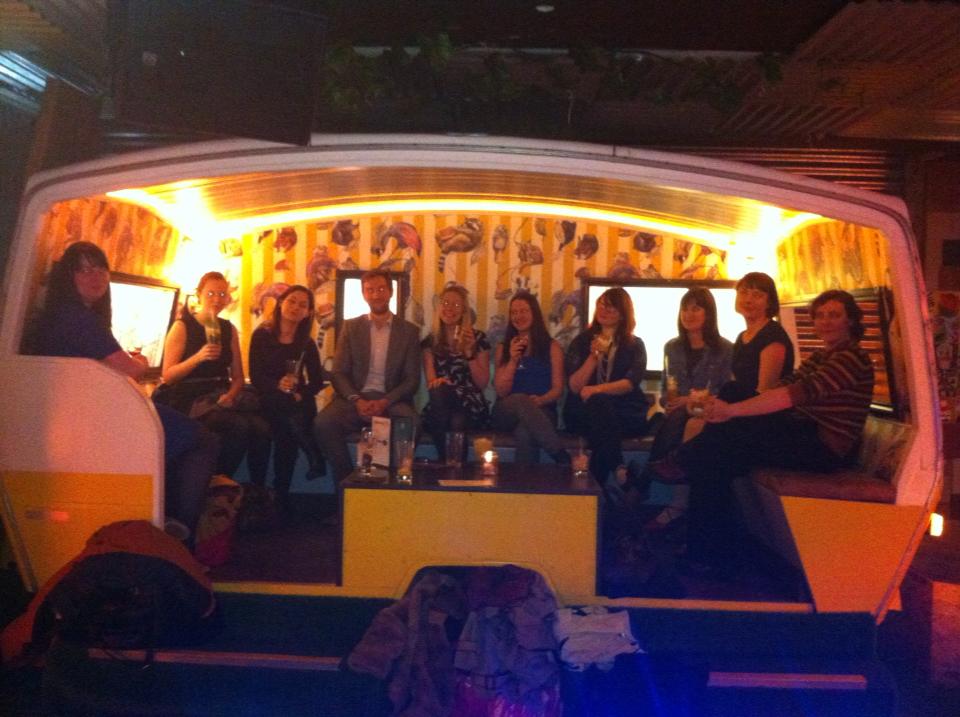
Last night I had my work leaving drinks at Barrio East on Shoreditch High Street. Having never been there before I wasn’t sure what to expect of my reserved area, ‘The Caravan,’ but it was everything I’d dreamed of and more.

What strikes you as you walk in the door of this South American-inspired bar is the brightly coloured lego-esque furniture in the front room. And from there onwards things keep getting quirkier, with splashes of colour just about everywhere you look. The friendly bartenders serve up an array of delicious cocktails (Top tip: Get there between 4pm and 8pm for bargain price cocktails and £5 discount on wine) as the music gets you in a dancing mood.

There are three different rooms or areas at Barrio East, each with its own distinctive style. But the one I liked best (and had, by happy coincidence, reserved for my gathering) was The Caravan. Located directly beside the dance floor, it is exactly what it says on the tin: A caravan. In a bar. Amazing. Seating up to 15 people (allegedly – though I’d say 13 tops if you want to be comfortable rather than elbowing each other in the face) it’s comfortable, wonderfully kitsch and also has the added bonus of feeling like an elevated throne from where you can look down at the drunken antics on the dance floor below with a self-satisfied smile.

An hour or so after we arrived, when we were happily ensconced in our self-styled ‘caravan of love,’ with bottles of wine and plate of nachos a plenty, the band arrived. It’s always a bit nerve wracking when a band turns up on a night out; it has the potential to either make or break the evening. But fortunately in our case it made the evening. Freddie and the Freeloaders (great name!) were just the ticket, and soon had us dancing away to their soulful tunes.

Weird as it sounds even the toilets deserve a mention in this place; when you walk in you could be forgiven for thinking you’ve been transported to Brighton seafront at the height of summer, with rows of painted beach huts (the toilet cubicles).

In short, this place is great – a little gem that’s a big break from the norm. If you like your bars to be crazy, quirky and kitsch then this is the place for you. Once you’ve tried it no local boozer will ever seem the same again. You have been warned…

A caravan. In a bar. AMAZING.

On Loss

Today is the funeral of a girl I know who tragically passed away in a car accident three weeks ago. She was just 32. Although I haven’t seen her for several years, I remember her as being beautiful, funny, kind and talented – she was an actress and, I recently learned, an aspiring playwright. I can’t imagine the pain her husband of two years is going through as he struggles to come to terms with the bottomless chasm of his grief – they were together since before I knew them, so he must feel he’s lost a part of himself. I just hope that one day he (and her family and friends) will be able to look back at the many happy memories they shared with fondness rather than pain, though I imagine that will take a very long time.

Being slightly removed from the situation by virtue of the time that’s passed since I last saw them, it feels somehow self-indulgent for me to wallow in grief. But I haven’t been able to stop thinking about her since I found out. It just seems so unfair that someone with such a zest for life, who showed so much promise in her career and was such an incredibly lovely person, should be so cruelly snatched away and cut down in her prime. I know the same could be said about everyone who dies young, I suppose this is just the first time it’s been someone who I really knew, and it’s come as a terrible shock because this is normally the sort of thing that happens to other people.

When I first found out I wrote a post about trying to take what little positives there are from such a tragedy, so I’m reminding myself now to make every day count, to tell everyone how much I love them and to be the best person I can be. But somehow all those promises feel like little more than hollow reassurances today, as I think about the fact a bright star isn’t with us anymore, and the sky will be a darker place without her in it.

I’m going to close with the poem I read at my grandma’s funeral years ago, by Mary Elizabeth Frye. It makes me cry every time but I think it’s beautiful:

Do not stand at my grave and weep,
I am not there, I do not sleep,
I am a thousand winds that blow
I am the diamond glints on snow
I am the sunlight on ripened grain
I am the gentle Autumn rain

When you awaken in the morning’s hush
I am the swift uplifting rush
Of quite birds in circled flight
I am the soft stars that shine at night
Do not stand at my grave and cry
I am not there, I did not die

Rest in peace, Katy. You may be gone, but you will never be forgotten x

I chose this picture for today because it was taken in one of the most peaceful places I’ve been, Taliwas in Borneo.

Productivity and pressure

Today’s mot du jour (said in a sophisticated French accent, naturellement) is “productive.” It’s 11.07am as I type this and already I’ve run five kilometres on the treadmill, sifted through the reams of crap accumulated in my desk drawers during my sixteen months here (binning most of it and saving a few nuggets that may be of use later on), applied for my New York visa, ordered both my travel money and insurance and made an exhaustively comprehensive to do list covering virtually every remaining minute of my working day (and indeed beyond, as this evening I’ll be helping my boyfriend move into his new place by lugging a massive suitcase from one end of London to the other in the name of love – or lunacy, I’m not sure which).

In short, I’m in the midst of a necessary manic phase, which has got me thinking about the nature of pressure. I don’t know about you but I have a love hate relationship with pressure. When I’m under huge amounts of it I panic; my hands sweat, my head pounds, my breathing is shallow. Sometimes (too often) I turn into a whimpering, gibbering mess in the corner, claiming between sobs that it’s all too much, I just can’t do it. But then a funny thing happens; I remind myself to breathe, drag myself out of the corner, put the kettle on and sit back down at my desk. And then I simply carry on. And you know what? If it wasn’t for the pressure bearing down on me I often wouldn’t complete the task I’d set out to achieve in the first place. In other words, much as it stresses me out, pressure is an essential part of my productivity. I work better with it than without it – and that’s a fact.

At school and university I could often be found at 2am the night before an important exam, cramming every bit of information I possibly could into my brain. It wasn’t that I hadn’t bothered to revise (well, it wasn’t always that), I just couldn’t focus properly until I was under sufficient pressure to be able to block everything else out. I’ll never forget the week before my dissertation was due when it dawned on me I really had left it too late, and I had to pull out every last stop to deliver on time. My body’s reaction to that particular period of pressure was somewhat extreme – I blacked out whilst hyperventilating over the choice of finishing my dissertation and attending a party. Needless to say I eventually (and sensibly, as wasn’t always customary in those days) opted to stay in and finish the dissertation, and thankfully went on to clinch an upper second degree as a result.

In today’s society pressure is, whether we like it or not, all around us. We feel pressure to succeed in every aspect of our lives, from our jobs to our relationships and even in our hobbies. Even those who seem, on the face of it, to be at the top of their game – the company CEO, for example – are under constant pressure to deliver better, smarter, cheaper. But the reason such people get to the top of their game is because they’ve managed to get a handle on the pressure and make it work to their advantage. They’ve understood that often pressure is a good thing which provides a necessary catalyst for change (if you don’t think change is a good thing, see yesterday’s post which, I hope, will change your mind – geddit?).

Now I’m afraid I really must be off, I’ve got a million and one things to do before the day is out and my hands are getting clammy….

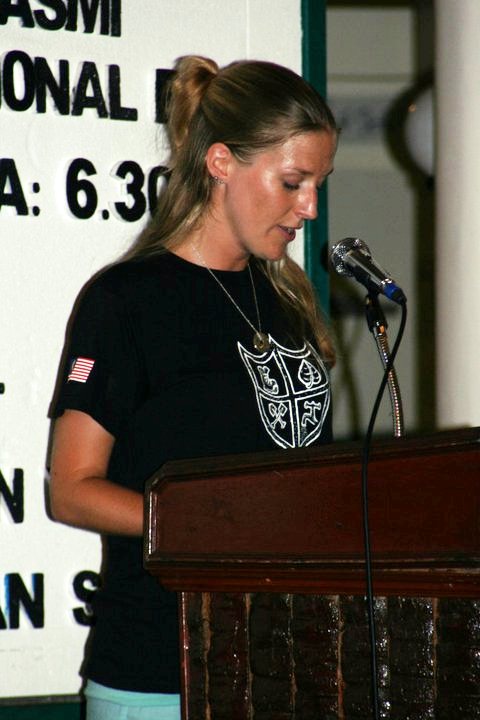
This photo shows me at a time when I was under considerable pressure – to host and deliver a successful end of expedition ceremony in Borneo in 2011. You can tell from the sweat on my brow I was nervous (and also brown – so brown, sigh…), but fortunately my effort was passable and the event was a success. See? Pressure in action. I rest my case.

Time flies

I can hardly believe my final week at work is already upon me. It’s a cliché, I know, but time really does fly – not so sure about the ‘when you’re having fun’ bit, but hopefully that’s still to come. This time next week, quite possibly, as I recover from this weekend’s 16 mile Wholefoods run in style with a trip to the Big Apple to visit the girl I affectionately call my ‘spiritual twin’ (so named after the two weeks we spent helping each other  cling to our sanity in an ashram in southern India in 2011).

After the events of the past few weeks a holiday is just what the doctor ordered, and I’m very much looking forward to taking some time out to reflect on the imminent changes in my life (not to mention start tackling the enormous writing-related tomes I’ve purchased in preparation for going freelance). The plan, thus far, is to sip coffee, nibble (oh alright, scoff) cake, down wine and eat inordinately large amounts of CHEESE – with a bit of sightseeing and a LOT of nattering thrown into the mix to boot. In short, we’re going to set the world to rights one mouthful at a time and I cannot WAIT.

Because of all the recent changes in my own life it’s no surprise that I’ve been ruminating on the nature and importance of change as a life driver. Should we, I wonder, embrace it regularly as a way to rejuvenate ourselves, or should we rather seek out a more preferable state of equilibrium, in which we can be happy to see out the rest of our days?

At the moment I’m inclined to think the former, not least because of this article I remembered having read a few years back about how the brain perceives time. The article discusses the central concepts of a book, Making Time, written by Steve Taylor. In it, he claims that as we get older it seems as though time is speeding up, but that’s only because we fall into hum drum existences and get caught up in the same old cycle, day in, day out. If we seek out new experiences – for example by filling our weekends with trips to art galleries, coffee in kitsch new coffee houses and lunches and dinners in new locations with friends and family – then our perception of time actually changes and we view it as having passed more slowly than it actually did.

It could be argued that this is counter-intuitive, since the sensation of being bored often feel s as if it spans a lifetime, but if you stop to consider how fast the last five years have gone since you joined your current company you might begin to give credence to the idea.

As I’m no expert in how to live life, I’ll close with a quote from Steve Taylor’s book:

“Make sure your life is as full of new experiences as possible. If you live a life that’s full of routine, then time will always speed up but if you make an effort to travel to new environments and expose yourself to new situations, new challenges, even something simple like a new route to work, new interests, new hobbies, then this degree of newness slows down time.”

It seems a pretty compelling argument to me. Now where DID I put that passport….?

533237_10152577828025057_891854652_n

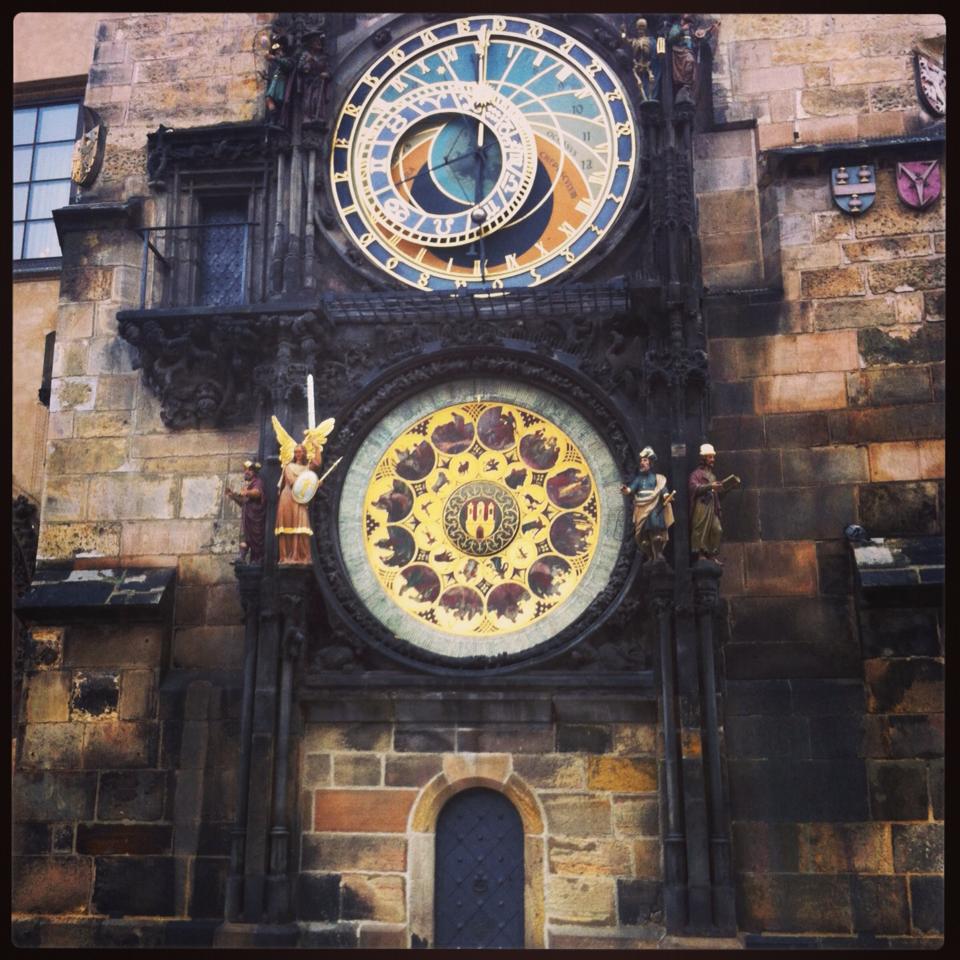
I fell in love with this clock in the main square of Prague’s old town. It looks like a time machine!

Hot tub dreamin’

Since Hot Tub Cinema the other week hot tubs have (unsurprisingly, I suppose) been on my mind. And not just my mind, it would seem, as a friend of mine has now decided he wants to hire a garden full of inflatable ones for his upcoming birthday (how brilliant is that?!)

Looking back beyond hot tub cinema I think the seed of my obsession may actually have been planted last summer when, two days before I was due to attend the Secret Garden Party festival in Cambridge, a friend who’d had to drop out offered me her ticket for ‘Bathing in the Sky.’ For the princely sum of twenty-something pounds I had procured a ticket to what I couldn’t have known then would prove to be a lifeline on the third day of a particularly muddy festival.

Inside this veritable Garden of Eden were not only the most delightful wooden hot tubs, set amongst a leafy green Hobbit-esque enclave away from the grubby horrors of the camp site and stages, but also shower facilities that would leave even the filthiest of revellers gloriously clean. In short, the two hours I spent there with my boyfriend and my best friend were amongst the best of my life, and I emerged feeling like a new woman.

Given my soon-to-be-part-time employment status I’ve no idea why I started browsing the internet and torturing myself with all of the amazing hot tub options on the market (although I couldn’t help but notice Arctic Spas do an ‘extreme bargain’ option on reconditioned, used hot tubs – surely I could save up for one of those?!), but what I am increasingly beginning to feel is that, until I have a hot tub to call my own, I simply will not have ‘arrived’ in life.

Picture this: After a hard day’s work you come home, walk through the door, hang your coat up and go upstairs to change into your fluffy white bath robe and slippers. Moments later you walk through the kitchen, pour yourself a glass of chilled Prosecco and open up the doors to the patio, upon which sits a glorious hot tub. Steam swirls invitingly up from its surface as you remove your robe and sink beneath the water. Within moments your troubles are all but forgotten and you are transported somewhere else entirely; your muscles relax, you close your eyes and you are home. Doesn’t everyone dream of this?

Okay, maybe not everyone, but few could deny a hot tub is a welcome addition to any ski holiday. Thus far in my skiing career (and I use the word ‘career’ loosely) I can’t say I’ve been able to afford a chalet with its own private hot tub, but just as in my previous example I imagine it would be a thing of great beauty and a most enjoyable experience to dip a post-ski frozen toe into the warmth of the water within.

It’s the decadence, really, that I covet. Nobody needs a hot tub to survive, granted, but what a lovely treat to come home to. There must surely be some research somewhere on the positive benefits of owning one; I’d hazard a guess they reduce stress in much the same way as owning a cat (though don’t quote me on that).

But until my freelance career sky rockets I’m sad to say my dream of owning a hot tub – reconditioned or otherwise – looks to be just that: A dream. So in the meantime I suppose I’ll have to make do with stroking the cat (and, come to think of it, I should probably start saving for a house to put the hot tub in…)

Image

what’s mine is yours?

At the end of last night’s Satsang class at the Sivananda ashram (which I mentioned in yesterday’s post) the yogi leading the class discussed the importance of not getting too attached to material possessions. In the Bhagavad Gita, the Hindu scripture that underpins the philosophy of yoga which the ashram teaches, Swami Sivananda refers to humans as the ‘caretakers’ of everything they come into contact with in life, rather than the owners. We are all, he says, ‘passing pilgrims’ in this world, which is why the whole concept of ownership is one that he discourages.

The yogi gave the example of someone saving up to buy their first house, who feels that in the exchange of deeds they are laying claim to that property and making it their own. Yet the reality is that such an arrangement is only ever temporary because, ultimately, the end of life will sever all such ties. It follows, then, that everything else we humans like to stamp our ownership on is also merely temporary – including our relationships.

I really like the idea of being a ‘caretaker’ rather than an ‘owner.’ To give an example of why, when a person borrows an item of clothing they generally take care of it more than if it were their own, because they know at the end of the day (or week, or month) they’re going to have to give it back (after all, it would be pretty embarrassing giving something back in a much worse state than the one in which it was loaned).

I think that as a society we would do well to stop and think sometimes about the way in which we regard the things – and indeed people – closest to us. If everyone had in mind that they were ‘passing pilgrims’ the world might, I believe, be a better place to pass through.