Bank holiday ramblings

Today is an April showery-May-the-4th. Not having anticipated this in the wake of several glorious days of sunshine, this means I am umbrella-less, and therefore at the mercy of the weather gods. The situation is further compounded by two factors. Firstly, not only is today April showery in nature, it is also blustery. This, perhaps, bodes not well for a rooftop (ergo ‘open air’) party in East London. Secondly, sleep deprivation levels are high, my fail safe plan of having a quiet night in to prepare for the weekend having been woefully unmatched by the plans of the other residents in the abode in which I slept. Hence there has been no morning run around Regents Park (though see earlier point about rain-does this let me off the hook on that one?)

In short, conditions for embracing a full on weekend of social engagements are far from optimal. But you know what? It doesn’t even matter. Because not only is it a bank holiday weekend (I’ll admit it smarts slightly that I won’t be paid for Bank Hol Monday, since Mondays are my official days off now I’m part time), I’m also en route for baby cuddles in Herne Hill. And everyone knows baby cuddles make EVERYTHING better.

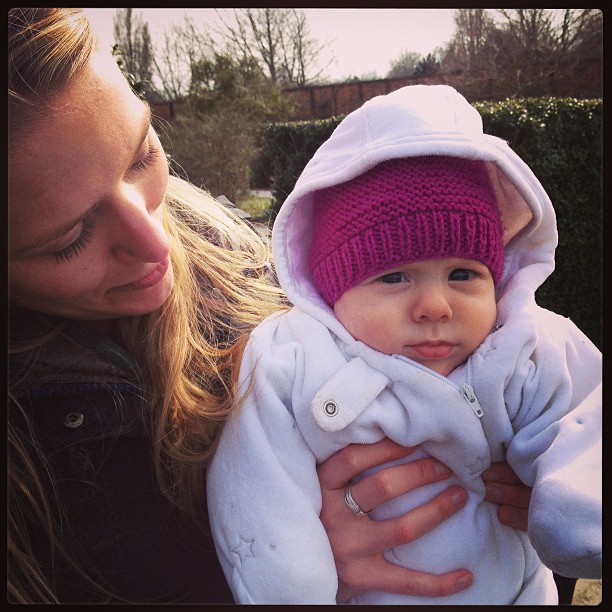
As i don’t have a snap of today’s cuddle, here’s one that was made earlier (ie last time)

Ruby

For today’s post I’m going to take one of the characters of my new novel for a quick test drive, to see how we get along with one another….

It was a clear day; sunny and warm, the seemingly endless blue sky punctuated by infrequent puffs of white cloud. Camden Lock was thriving with people; predominantly foreign students and punks with brightly coloured spiky hair and platform steel toe-capped boots.

Ruby loved the diversity of the crowd, the way it ebbed and flowed around her like the tide. She shrugged off her black leather jacket and let it fall onto the guitar case at her feet. Running her slender fingers through her coarse blond hair she yanked it away from her face, securing it without ceremony at the nape of her neck with a hair tie and pulling the ponytail out of reach of the guitar strap around her neck.

She’d bought the guitar with the last of her savings, not long after she’d arrived in London. At the time it had seemed like madness to part with all that she had, but she’d trusted in the providence of her musical ability, and whilst it hadn’t yet paid dividends it was at least keeping a roof over her head. Well, that and the job at the frozen yoghurt parlour – and Max’s hospitality, of course, though the true motives for his generosity were plainly evident, if not to him then everyone they knew.

She wouldn’t play for long now. This impromptu set was just to warm her vocal chords up ahead of the main event; her first live gig with the band. Tonight’s competition at Barfly would be the culmination of five years of hard work and determination, and failure was not an option.

This is the lead singer of Slow Club, who was the inspiration for Ruby’s character (though any similarities between the two are purely coincidental).

Is there a cost to reaching our full potential?

So many of us spend our lives rushing around, jumping from one task to the next with scant regard for the strain we’re putting on our minds and bodies by not giving them a rest from time to time. But if we spend too much time resting will we ever achieve our full potential?

According to Dictionary.com, potential is defined as “possible, as opposed to actual,” or “capable of being or becoming.” Would it not follow, therefore, that to reach one’s full potential one must be entirely capable of becoming their best self? And that to be entirely capable one must be entirely focused all of the time – thus relinquishing leisure pursuits and anything unrelated to the ultimate goal?

Take wanting to be a published author as an example; it’s all very well wanting it, but if you don’t have the drive and determination to stick at it when the going gets tough how can you expect to succeed? It’s a well-known fact that even JK Rowling herself was rejected countless times before finally reaching the heady heights of success. She achieved her potential only by working through the low moments instead of giving up, and rising, Phoenix-like from the ashes of the rejection pile to come back stronger and more inspired than before.

Of course the danger of not resting enough is burn-out. It would clearly be unwise to never take a break from your desk, because your productivity levels would suffer due to tiredness. Nobody can concentrate for eight hours in a row – well, maybe David Blaine, but apart from him no one (surely?)

The key to achieving your potential, then, is simple (and best said in the words of the great Winston Churchill himself): Never, never, never,never give up. Unless, that is, you are in dire need of a rest. And, perhaps, an accompanying glass of chilled Pinot Grigio. And on that note…

I think this is the best photo I’ve ever taken, and it perfectly encapsulates the concept of never giving up. This was part of an exhibition at the London Zoo – ants are just the most amazing creatures!

There’s no such thing as a ‘bad’ kid

I’ve just got back from my first afternoon visiting a Teens and Toddlers project at a nursery. Much as I’m ashamed to admit it I did have preconceptions about what the teenagers would be like. I’d assumed they’d be surly and uncommunicative, and that it would be difficult to engage with them, especially given that the teens on our programme are chosen precisely because they’re deemed to be more ‘at-risk’ (of dropping out of school, having children young etc.) than their peers.

But I’m delighted to say my experience was a total eye-opener and my preconceptions have been shelved. The six boys on the project I visited are all thirteen years old, and whilst they are typical teenagers who don’t always listen, aren’t all that keen on looking you in the eye and occasionally act up, on the whole they’re really lovely kids.

Classroom sessions aside, the real joy for me was seeing the way the boys interacted with their ‘toddlers’ in the nursery. It was a gloriously sunny afternoon which meant the toddlers were racing around outside in the play area. One of the boys had arrived at the nursery fuming about having had a personal possession stolen at school, and the facilitators were initially reticent about allowing him into the nursery to see his toddler, lest he carry his anger through to their session. Once he was out there, however, he was totally unselfconscious and behaved impeccably with his toddler. He even had a number of toddlers gathering around him to play because he was so much fun to be with.

Another boy, who had in the earlier classroom session refused to look any of us in the eye and acted bored, came alive with his toddler and spent ages lying on the ground play-fighting with them. I saw each of the six interacting with their toddlers in such a heart-warming way that it made me see every one of them in an entirely new light. When we returned to the classroom after the session with the toddlers they were alive with enthusiasm and keen to talk about the progress they had made with their toddlers.

At one point in the classroom we discussed what age would be the right age to have children. All the boys unanimously agreed that older than twenty five was ‘past it’ as far as they were concerned, which made me – a childless woman of thirty one with no immediate plans to have children – laugh. It’s been so long since I was their age I’d forgotten how old twenty five seems; like a lifetime away, though of course it’s really not.

Watching the boys – and the toddlers, come to that – today, it really wasn’t obvious that they have turbulent home lives. But I was reliably informed by the facilitator that some of them have an awful lot on their plates given their age. It’s hard enough being a teenager without having a host of problems to deal with in your personal life.

I’ve come away feeling more certain than ever that the work my charity’s doing with vulnerable children and disadvantaged teenagers is vital for the future of this country’s young people. No young person is inherently a ‘bad kid,’ it’s just that some of them need extra help to navigate their way through turbulent periods in their lives and stay on the right track. Shouldn’t every young person in that situation have the right to such help?

Meeting the boys today made me think of the boys I taught in Tanzania in 2007, some of whom were about the same age then as these boys are now. I wonder what became of them and where they are now.

A classy business

A photo article on ‘things posh people like’ is currently doing the rounds on the social media networks. It cites such accoutrements as ‘upturned collars,’ ‘expensive pets’ and ‘blazers,’ and pokes fun at ‘insanely long surnames’ and the tendency of the rich to ‘make lists of other posh people, most of whom you’ve never heard of.’ In short, it’s funny. Or at least it is to people like me, who regard themselves as middle class and consider this self-classification a prerequisite for being permitted to relentlessly mock the upper classes, with whom we obviously share no common ground.

For most people, identifying with a social class provides a meaningful form of identity. The ‘upper classes’ are easier to mock because they’re perceived as ‘having it all’ – something the lower and middle classes doubtless envy (even if they’re quite certain they wouldn’t behave in the same way should they themselves come into a substantial sum of money).

The stereotypical posh kids who are depicted on programmes like Made in Chelsea do little to make being ‘upper class’ look classy, parading around in sports cars and having friends over for champagne tea served by the maid before indulging in a spot of croquet and a polo tournament. They portray a life of undeserved over-privilege, which is both offensive and alienating to Joe Bloggs on the street, who’s struggling to put food on the table at the end of each long day.

But whilst ‘posh’ is easy to mock, isn’t it a kind of inverse snobbery that operates when the ‘lower classes’ club together to mock the way the upper classes look and act? Perhaps, but it’s human nature to seek out those most similar to ourselves and form a bond as a way of reaffirming our place in society. There’s strength in numbers, as the saying goes.

But whether we’re rich or poor, posh or common as muck, we mustn’t forget that we are all human beings – our outward circumstances may be different but inside we’re all the same, with the same insecurities and fears. So what if some of us like wearing tweed and others double denim? The chances are deep down we’ve got more in common than we realise – or perhaps that we’re prepared to accept.

Now if you’ll excuse me, I’ve got to meet a man about a peafowl….

enhanced-buzz-18798-1367242095-1

The paranoid extrovert

Human personality theories tend to divide people into two categories; extrovert and introvert. Whereas once it was accepted that for an individual to rank highly on one scale they must automatically rank lower on the other, later theories such as those of Carl Jung claimed that it was quite possible for an individual to exhibit characteristics of both, though one would be more dominant than the other.

According to the Merriam-Webster dictionary, extroversion is “the act, state, or habit of being predominantly concerned with and obtaining gratification from what is outside the self.” Introversion, therefore, is “the state of or tendency toward being wholly or predominantly concerned with and interested in one’s own mental life.” It follows, therefore, that extroverts are generally more talkative, outgoing and gregarious, and their introvert counterparts quieter, more withdrawn and less at ease in social situations.

What category, then, would the world’s writers and artists predominantly fall into? Is the spectrum as wide for this sub-category of the human race, or do the lines blur into one another a little more, like watercolour paint bleeding onto canvas? I only ask because I am (or at least I like to think I am) one of these strange creatures, and because whilst I would put myself firmly in the extrovert camp if asked the question, on further thought I wonder to what extent this is really true. Or rather, whether it’s possible to be an extrovert on the surface, but an introvert deep down inside, where insecurities breed like cancer and one thought spirals into a tornado of many.

Sometimes, for example, I’ll be mid-conversation with someone and my brain will put the brakes on and whisper like a bully in the school playground, “They aren’t remotely interested in what you’re saying, you know, it’s only through politeness that they’re pretending to be.” Even if the person with whom I’m conversing does seem genuinely interested in what I have to say, the voice in my head eats away at my confidence, making every word seem – to me at least – more laboured, less relevant, or just plain wrong. It’s a type of paralysis – thought paralysis, if you will – that makes me want to stop talking and run away and hide. And it’s really rather odd, because if you asked any one of the people closest to me they’d laugh and say that isn’t me at all.

Perhaps it’s wrong to link introversion with insecurity and a general lack of confidence. Many introverts may be supremely confident in themselves and their abilities but simply have no interest in hogging the limelight in social situations. It’s quite possible that makes them more rather than less confident, because they don’t feel the need to seek praise and affirmation in the way the extroverts do.

The part of the definition of being an extrovert that both grates on me and resonates with me is the “obtaining gratification from what is outside the self” part. Why do we extroverts feel the need to seek approval and reassurance to validate our place in the world? Why can’t we accept what is and be happy with our achievements irrespective of praise? All questions that my inner introvert is just dying to answer…
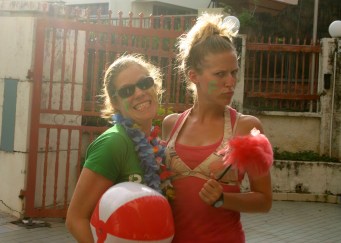
Not sure this picture – taken on my Raleigh expedition in 2011 during filming of a ‘music video’ – quite illustrates my point about being an introvert….

Past tense

If you get a chance to see the soon to be released Kings of Summer, one of this year’s Sundance Film Festival’s offerings, you won’t be disappointed. Unless, that is, you don’t like American coming of age dramas, in which case you might be best advised to steer well clear. But, for the purposes of this post, let’s assume this type of film does float your boat. Reminiscent of Stand by Me and set, in the main, in a house in the woods that three teenage friends built together, it covers the well-trodden territory of friendships made and broken, turbulent parent-child relationships and first love. The script is both funny and poignant, the setting charming and the actors superb; in particular the three boys who are the focus of the film. In short, it’s an engaging snapshot of the innocence of youth.

Ah, the innocence of youth; a time when everything seemed possible, the endless road of life stretching into a distance too far away to see and therefore too far off to worry about. There were immediate concerns, of course – like who was going on dates with whom, how you could get out of gym class and whether you could procure some vodka for the party at the weekend – but in the main it was so simple then. Wasn’t it? Or was it?

Remembering the past with fondness is a good thing because, whether good or bad the things that happened to you then have shaped the person who you are today. But clinging onto the past and believing that things were better than they are now isn’t healthy. What’s even worse is if you feel the best phase of your life is past, that you’ll never look as good again, or be as carefree, joyous or happy-go-lucky.

The passage of time makes it all too easy to forget the negatives and re-paint the past with a rosy hue that wasn’t always (if ever) present. When things go wrong in life it’s easy to revert to happier times in our thinking and to ardently wish we could rewind the clock and do it all again – only this time making different choices to avoid making the same mistakes.

But if you find yourself flooded with nostalgia about days gone by, ask yourself this: If you could choose to flick a switch and be your fifteen year old self again, go through your adolescence again, warts and all, would you take it – really? Or would you rather keep the memories of roaming the woods with best friends, long summers and first kisses as just that – memories to be treasured, but not pored over as examples of better times?

No matter how old you are the future seems far too far away to see. Who knows what adventures still lie ahead of you? And how many opportunities you’ll miss by always looking back?

photo (2)

“He who tires of London tires of life”

When you live in one of the most famous cities in the world it’s surprisingly easy to forget the myriad reasons why it’s so famous. The views, of course, are self-evident (nothing beats the London skyline as dusk falls over the South Bank), but it’s the hundreds (if not thousands) of attractions, exhibitions, walking tours, wine tastings, cake makings, tea drinkings, secret supper clubs, underground speakeasys [sic] and quirky activities that often get disregarded by the folk who reside here.

Why? Because, after spending five days of the week battling through the crowds on public transport to and from the office – not to mention attempting to juggle catching up with friends, working late and working out – they’re usually too exhausted and/or hungover to do anything other than throw themselves into an arm chair with a cold beer and vegetate for two days.

Most city workers don’t even contemplate a trip to the National Gallery, a cruise on the Clipper boat from Greenwich or a cocktail making master class on their long-awaited weekends. Or, if they do contemplate it, it’s usually too late in the day to actually make it a reality.

And on those rare occasions when they do have the energy for a weekend excursion it’s usually to somewhere outside of London – because after the week they’ve had the last thing they want to do is run the gauntlet of tourists in Piccadilly or Oxford Circus, or any of those other tourist meccas.

But Londoners really should take the time to appreciate the city in which they live. Especially the young professionals who know their time here is limited, that they’ll move on in a few years when another opportunity – possibly the desire to start a family – presents itself. Because it’s often only when you leave a place that you realise how incredible it really was – and feel nostalgic for the things you never did, even though you had the chance.

411654_10151162262550057_238806214_o


April showers

The alarm goes off. You open one eye, wary of the encroaching day. One foot hangs over the edge of the bed and you wiggle your toes to determine the air temperature before reluctantly throwing off the covers and getting up. As you trudge towards the bathroom you pull back the curtain and grimace. The sky is full of dark grey clouds, pregnant with rain. You fight the urge to return to bed and continue on your slow pilgrimage towards the shower mecca (which may not make you ready for the day but will at least erase the fug of sleep from your head and the dried spittle from the corners of your mouth).

You shower and dress in sensible clothes that are appropriate for the gloomy weather; a woollen dress, thick tights, a cardigan and jacket. You grab an umbrella and head out of the door. It starts to rain as soon as you step outside the door but you’re prepared, and so you open your umbrella and continue on your journey to work.

By lunchtime the wind has got up, rendering your brolly useless against its mighty power. You battle your way through the hurricane to buy your lunch and retreat back to the office, thankful that you were at least sensible enough to bring your winter coat.

After work you step out of the office to find the wind has died away and the sun is shining brightly. It’s several degrees warmer and there’s not a raincloud in sight. As you’re going for drinks it seems ridiculous to take your winter coat with you, so you decide to leave it in the office, along with your umbrella which is also hardly required in these conditions.

The alarm goes off. You open one eye, wary of the encroaching day. Your head is pounding from the previous night’s excesses. As you trudge towards the bathroom you pull back the curtain and grimace. The rain is beating down so hard the street is barely visible. Still, at least you’ve got your winter coat and umbrella. Oh no, wait…they’re at the office. You admit defeat and retreat to bed.

The view from my office window demonstrates the unpredictability of April weather – one set of white fluffy clouds and one set of foreboding grey ones, with a strip of blue sky inbetween. Talk about confusing – how’s a girl ever meant to know what to wear?!

The dark side of ‘celebrity’

In a recent interview with GQ magazine, Beyonce Knowles was reported to have said: “I am more powerful than my mind can even digest and understand.” Elsewhere in Celebville, the normally mild-mannered Reese Witherspoon got arrested for drunkenly slurring at police, “Don’t you know who I am?” Whilst we might expect such behaviour from traditionally ‘troubled’ celebrities such as Lindsay Lohan, these latest displays of arrogance are more surprising. Are we, one wonders, to assume they are momentary lapses of concentration – wherein the masks of niceness that Beyonce and Reese wear so well have slipped and exposed the ugly natures that lie beneath? Or could it be that they were goaded into making what many no doubt view as being obscenely self-indulgent remarks – that these incidents were, in fact, one offs, never to be repeated?

To be fair to Reese she was – allegedly (no libel lawsuits here thank you very much) – under the influence of considerable amounts of alcohol at the time she made her remarks, so we could perhaps give her the benefit of the doubt. But Beyonce? It’s hard to speculate, but subsequent news reports insinuating that the only photographers allowed at her concerts are those employed by her own company (lest she be photographed from an unflattering angle, revealing – once again – that in reality she’s actually less than perfect) add weight to the argument that she’s a control freak; a quality that is in itself but a hop, skip and a jump away from blind arrogance and egotism.

Whether we like it or not, the fact is that obsession with celebrity is a feature of our times. We have, by virtue of our continuing interest in the lives of pop stars and actors such as Beyonce and Reese, created the monster that we see before us. It may well provoke outrage that stories of celebrities mouthing off about their power and success are interspersed on popular news sites with ‘real’ news stories – like those of the Boston bombings, Waco explosion, Chinese earthquake and recent factory collapse in Bangladesh – but the truth is our society is just as interested in them, if not more so.

Of course everyone is entitled to a slip of the tongue every now and then. And there’s no reason why celebrities shouldn’t revel in the fame they’ve worked hard (in most cases) to achieve. But before they revel too much it might be worth sparing a thought for their legions of adoring fans, and considering the example that they’re setting for future generations. You may well be powerful, Beyonce, but why not use that power for good instead of as a bragging tool for ugly self-promotion?

Image

Didn’t have a suitable pic for today so I improvised – never let it be said I’m not creative!