Sadness

At times in my life when I’ve experienced loss, grief and sadness I have often found it greatly cathartic to write about it. I suspect many other writers find that being melancholy is more conducive to being prolific in their craft than being happy, perhaps because it makes for more heartfelt and genuine content that the reader can not only engage with but also empathise with.

But sometimes when something is so recent and raw it’s hard to write about it, and that’s where I am right now. It takes time to process a tragic event and whilst you’re doing it there’s little space for anything else, which is why I’m finding it hard to carry on as normal with my daily blog posts-and indeed why I missed posting yesterday’s despite having written it on time.

Your brain closes down a bit to process grief, ignoring all non-essential things and effectively hibernating until the pain has lessened. I am only on the periphery of this terrible situation and yet I have been deeply and profoundly affected by it, and I feel an enormous amount of sympathy and sadness for those involved. I can’t say any more for now, it wouldn’t be fair. I just wanted to explain why I’m not quite myself, and why my daily musings are temporarily distracted.

Beauty Queen

Blankly she stares through mascaraed eyes, a soulless being with a painted face. For hours a tumultuous swarm of activity has ebbed and flowed around her. It is only now, with moments to spare, that the hurricane winds gather pace. Faceless fingers tug her hair into a style that defies both gravity and reason. Yet more tend to her nails, pinch her cheeks, tweeze her brows. Quietly she sits in the eye of the storm; watching, waiting.

From behind the chair upon which she is borne aloft a camera clicks. She smells the cloying odour of stale alcohol before she sees the photographer’s face in the mirror. Sweat oozes from his forehead like ectoplasm, sticky and wet. His lips purse, he blows a kiss at her then laughs, spittle forming at the corners of his mouth. She does not respond, merely looks away.

Her rosebud lips are painted pink, a final wash of blusher applied to the apples of her cheeks. She steps down from the chair. Her vantage point lost, she feels her diminutive stature acutely. The layers of cream and pink tulle on her princess cut dress are adjusted. Her feet are prised into crystal slippers; replicas of Cinderella’s, or so they told her. A cloud of perfume and hairspray shrouds her, stinging her eyes and throat like nettles. Now she is unrecognisable even to herself, she is ready.

The curtains pull back and she steps onto the runway, drawing collective gasps. “Isn’t she beautiful?” “What a darling little thing.” “Only five years old, you say? Well I never.” “Adorable.”

In the glare of the studio lights nobody notices the single tear that slides unbidden down her painted face, dropping from her chin into obscurity.

This gorgeous little girl was at a centre for disabled children that I visited in southern India. She’s quite the opposite of the girl in my story – naturally beautiful and enjoying her childhood, just as she should be.

Fight hate with love

Like many I was shocked and horrified to hear of the bombs that rocked yesterday’s Boston marathon, killing three – among them an 8 year old boy – and injuring many more. When I expressed my outrage at this latest tragic atrocity, however, I was shocked when someone challenged me to explain why it was any more tragic than the almost daily bombings in Iraq or Syria.

Ever since it was asked of me that question’s been playing on my mind in a loop – in much the same way as the video clip of the Boston marathon bombs going off has been played on every network since it happened. Did I feel more sad hearing about the marathon victims than when I heard news reports of innocent civilians being blown apart in Iraq? If so, what did that say about me? Was it possible some form of racism, classism or snobbery had crept into my consciousness without me even noticing its existence? Did I, in truth, value the lives of those people in Iraq less than the lives of the marathon spectators?

After a thorough period of introspection I’m pleased to say the answer to those questions was a resounding no. Whether they lost their lives in Boston or Iraq, I feel the same deep sense of sadness, the same feeling of shame that there are other human beings capable of such terrible acts of malice and hatred against their fellow men, women and children. The Boston bombings aren’t, therefore, more tragic; not at all. But, for those of us in the western world who are fortunate not to live in war torn countries, it is more shocking. Why? Because, quite simply, it’s far less common for a bomb to go off in the middle of a marathon taking place in an American city than it is on a normal day in an Iraqi city.

And there’s another reason. We see so many international news reports featuring the images of bloodied, limbless children’s corpses and wailing men and women beating their chests with grief that we are systematically desensitised to their effects. We’re used to death in Iraq and Syria. What we’re not used to is death in our own communities – or at least not the kind of death we witnessed yesterday in Boston.

No matter where terrorism strikes it sends shockwaves through not only the community whose beating heart it strikes, but also across the world. But whilst each time they strike the terrorists may think that they are winning the fight, what their hate-filled hearts will never comprehend is that through love for our fellow men it is we who will win the war.

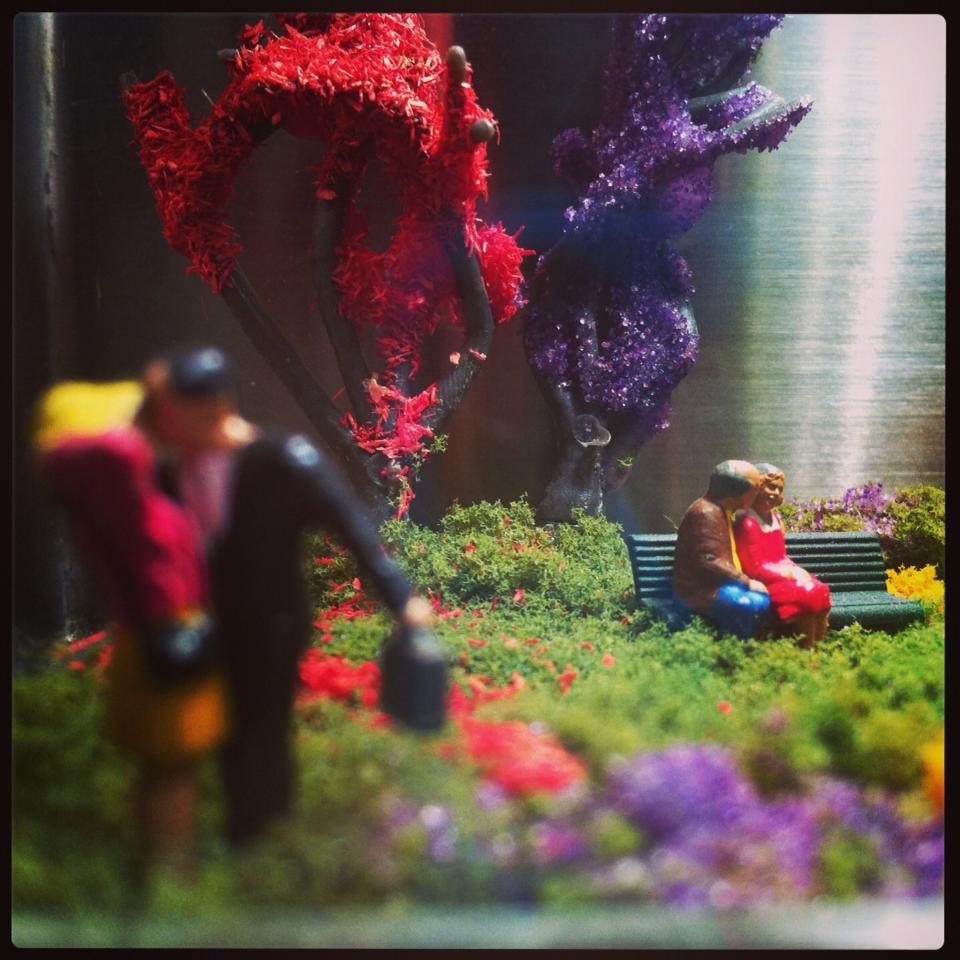
I fell completely head over heels with this, a tiny model scene in the wall of a toilet in a Manhattan restaurant. I think it’s quite appropriate given the end of today’s post.

On Loss

Today is the funeral of a girl I know who tragically passed away in a car accident three weeks ago. She was just 32. Although I haven’t seen her for several years, I remember her as being beautiful, funny, kind and talented – she was an actress and, I recently learned, an aspiring playwright. I can’t imagine the pain her husband of two years is going through as he struggles to come to terms with the bottomless chasm of his grief – they were together since before I knew them, so he must feel he’s lost a part of himself. I just hope that one day he (and her family and friends) will be able to look back at the many happy memories they shared with fondness rather than pain, though I imagine that will take a very long time.

Being slightly removed from the situation by virtue of the time that’s passed since I last saw them, it feels somehow self-indulgent for me to wallow in grief. But I haven’t been able to stop thinking about her since I found out. It just seems so unfair that someone with such a zest for life, who showed so much promise in her career and was such an incredibly lovely person, should be so cruelly snatched away and cut down in her prime. I know the same could be said about everyone who dies young, I suppose this is just the first time it’s been someone who I really knew, and it’s come as a terrible shock because this is normally the sort of thing that happens to other people.

When I first found out I wrote a post about trying to take what little positives there are from such a tragedy, so I’m reminding myself now to make every day count, to tell everyone how much I love them and to be the best person I can be. But somehow all those promises feel like little more than hollow reassurances today, as I think about the fact a bright star isn’t with us anymore, and the sky will be a darker place without her in it.

I’m going to close with the poem I read at my grandma’s funeral years ago, by Mary Elizabeth Frye. It makes me cry every time but I think it’s beautiful:

Do not stand at my grave and weep,
I am not there, I do not sleep,
I am a thousand winds that blow
I am the diamond glints on snow
I am the sunlight on ripened grain
I am the gentle Autumn rain

When you awaken in the morning’s hush
I am the swift uplifting rush
Of quite birds in circled flight
I am the soft stars that shine at night
Do not stand at my grave and cry
I am not there, I did not die

Rest in peace, Katy. You may be gone, but you will never be forgotten x

I chose this picture for today because it was taken in one of the most peaceful places I’ve been, Taliwas in Borneo.

Description

How can I describe you?

Your beauty and your ugliness go hand in hand, they cannot be separated. You have many faces. Like a kaleidoscope you dazzle all who look upon you. Some see truth, some see excitement, others see only sadness and despair-but all have strong reactions.

You are the opposite of bland.

You are a mirage, ever-shifting and changing. You offer life, yet you bring death. You are never quiet, never still. You suffocate, intoxicate, annihilate. You provoke debate.

Like a boa constrictor you wrap yourself around your prey while they are unaware and squeeze the life from them, bit by bit. Like a Venus Fly Trap you lure your victims in with sweet nectar before drowning them in toxic secretions.

You twist and turn, you ebb and flow. You smoke and burn, you shrink and grow.

You breathe the collective sighs of thousands.

You build up and you break down. You belong to everyone and no one.

You are the sweetest of scents and the foulest of odours. You are music, you are movement. You are passion.

Your light may, at times, diminish. But it will never be extinguished.

You are a multitude of things.

London: How I love you.

Image

This is my favourite view of London, it signifies everything that’s great about this crazy City in which I live.

Mary

The snow fell in fat flakes onto the ground, obscuring all that lay beneath. A dog nosed in the undergrowth near a mound of earth cloaked in white, digging up wet leaves with its paws, trampling what little grass had managed to poke through the thick covering above. The dog sniffed, its nostrils flaring as it seemed to catch a scent of something that excited it, but a distant whistle from its owner bid it come, so it turned on its heel and ran off.

Mary had never been fond of dogs, but as she watched it leave she felt a pang of sadness. It was so bitterly cold even the thought of sharing body heat with an animal was an appealing prospect. A flash of red caught her attention. She squinted through the falling snow and saw a tiny figure in the distance, weaving its unsteady way across the vast expanse of field between them.

It took Mary several moments to realise the figure was a small child, and by that time it was almost upon her. She grimaced. Her dislike of dogs was on a par with her dislike of children, and in her current situation she was not disposed to tolerance.

As the figure drew near Mary saw it was a little girl, not more than three years old, four at most. Her red duffel coat had a fur-lined hood and matching red mittens that hung from her sleeves on lengths of elastic. They bounced up and down as she ran, dancing in the air as if marionettes on a stage. Her blue plastic wellington boots, too big for her small frame, made her progress ungainly.

Breathless, the girl stopped. Up close Mary could see she had a cherubic face, with rosy cheeks, pink bow lips and porcelain skin. A lock of curly blond hair had escaped from her hood and was dangling in front of her nose, which twitched in irritation. She blew it away with a concerted snort and looked at Mary. “Hello,” she said, unblinking.

“Hello,” Mary replied. “What are you doing out here all by yourself?”

The girl shrugged. “I ran away.”

“From who?”

“My mummy.”

“And why would you do a silly thing like that?” Mary scolded the girl. “She’s probably very worried about you.”

The girl frowned as she considered the implication of her older companion’s words. “But she was horrible to me,” she said at length, her jaw set in defiance.

Mary sighed and patted the bench. The little girl obligingly climbed up beside her. “I’m sure she didn’t mean to be horrible. Sometimes people say things that they don’t mean in the heat of the moment.” A memory came to her then; a heated exchange, doors slamming, raised voices. She felt a lump form in her throat but carried on. “I’m sure your mummy loves you very much.”

“She doesn’t,” said the girl, folding her arms across her chest. “I’m not going back.”

“Oh?” said Mary, raising an eyebrow. “And what will you do instead, exactly?”

The girl shrugged. “I don’t know. Find a new family, probably.” She chewed on one of her mittens.

“Do you think new families are easy to find?” Another pang, another memory of issues unresolved, words spoken that could never now be taken back.

The girl shrugged again.

“Well I can tell you from my own experience that they’re not.”

The girl looked up at Mary. “Did you run away?” she asked, her brown eyes searching.

“Yes, in a sense, I suppose I did.”

“What happened?”

Mary took a deep breath. Was she really about to tell a child what she had never been able to tell an adult?

“I had an argument with someone very close to me, a long, long time ago. We never spoke again. I think it was the biggest mistake I ever made, but it’s too late to go back and change it.”

“Why too late?” The little girl shivered and nestled into Mary’s side. Without thinking she wrapped a protective arm around her, catching herself in surprise.

“Because that person – my mother – died.”

The girl’s eyes widened. “How?”

“In a terrible accident, the day after our argument. So you see, you really must go back and find your mother. You don’t want to have the same regrets as me do you?” The girl shook her head, her face solemn.

The sound of frantic cries sliced through the air like a knife, distant at first, then louder, more insistent. Mary turned to see a woman running towards them. “Alicia!” she screamed upon seeing her daughter, and flung herself down onto her knees in front of the bench to scoop her into a tight embrace. “Where have you been? I’ve been looking everywhere.” She examined her daughter’s face, smothered her in kisses. “You must be freezing.”

“I’m not freezing, mummy,” Alicia said. “The nice lady was keeping me warm.”

Alicia’s mother looked around. “What lady?”

The girl turned and pointed to the bench beside her. A look of incomprehension crossed her face. “She was just here…” Her little voice trailed off.

The woman’s laugh was pure relief. “Of course she was darling.” She kissed her daughter on the top of her head and stood up. “Come on darling, let’s go home.”

“But…” Alicia stared into the space where the old lady had been, her mouth open. She cast her eyes about her one last time before turning to leave.

Mary watched them walk away. She looked down at the white-topped mound before her and wondered how long it would be before someone found her body, lifeless beneath the snow, exactly as she had fallen. Her life for so long had been solitary, it seemed ironic that in death she had, for the briefest of moments, found companionship.  It was time to go.
483471_10152317714200057_892344886_n

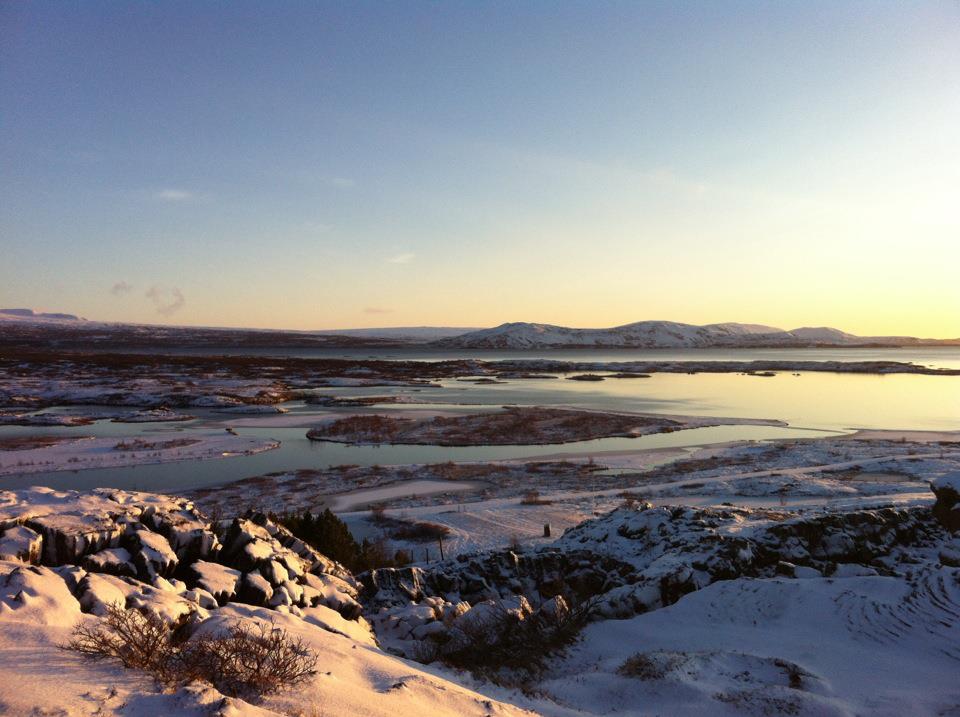
I can think of no better image to accompany this post than the title image of this blog. The day before this picture was taken was a complete white out, and my boyfriend and I scuba dived in the lagoon though we could barely see two feet in front of us. When we returned the following day in gorgeous sunshine we were gobsmacked by the scale and beauty of the place. it was so calm and serene, so utterly and unequivocally beautiful.